
EYFS guide · Early years practice
The 7 areas of learning in the EYFS
The Early Years Foundation Stage (EYFS) sets out seven areas of learning that shape every child’s development from birth to the end of the Reception year. They are split into three prime areas and four specific areas, and good practice means weaving them together rather than teaching them in isolation.
What is the EYFS?
The EYFS is the statutory framework that all Ofsted-registered early years providers in England must follow, including nurseries, childminders and reception classes. It covers learning and development, assessment and safeguarding.
At the heart of it sit the seven areas of learning, which describe what children should be supported to learn, and the Early Learning Goals, which describe what a typical child should have achieved by the end of Reception. There are 17 Early Learning Goals in total, spread across the seven areas. Understanding how the areas fit together helps practitioners plan, observe and talk to parents with confidence.
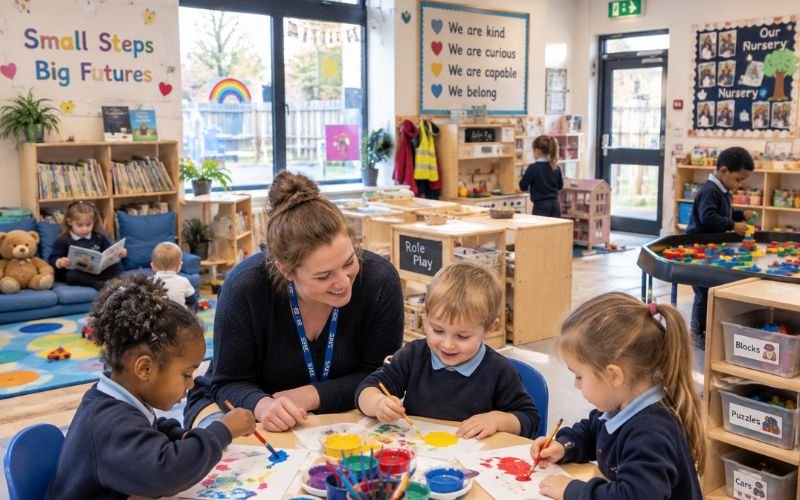
The 7 areas of learning and development in the EYFS
The UK Early Years Foundation Stage (EYFS) framework sets out seven areas of learning and development, supported by 17 statutory Early Learning Goals (ELGs). These areas are divided into three prime areas, which establish the foundations for learning and development, and four specific areas, which help children broaden and apply their knowledge and skills.
The table below summarises the seven areas and their Early Learning Goals, as set out in the Department for Education’s EYFS framework.
| Category | Area of learning | Statutory Early Learning Goals (ELGs) | Focus and core skills |
|---|---|---|---|
| Prime areas | Communication and Language |
| Developing vocabulary, spoken language, active listening and comprehension. |
| Physical Development |
| Building coordination, balance and control through large movements and precise actions, such as running, jumping, drawing and using tools. | |
| Personal, Social and Emotional Development (PSED) |
| Developing emotional regulation, independence, self-confidence, positive relationships and an understanding of routines and boundaries. | |
| Specific areas | Literacy |
| Developing early reading and writing skills, including understanding stories, recognising words, applying phonics and expressing ideas through writing. |
| Mathematics |
| Developing number knowledge, counting, subitising, understanding quantities and recognising numerical relationships and patterns. | |
| Understanding the World |
| Exploring the past, understanding different people and communities, and observing nature, environments and living things. | |
| Expressive Arts and Design |
| Exploring creative materials, art, music, movement, role-play and imaginative expression. |
Free download
EYFS 7 areas of learning checklist
A printable checklist of all seven areas and 17 Early Learning Goals to use for planning and observations.
The three prime areas of learning
The prime areas come first because they are the foundation for everything else. They are the most essential for a child’s healthy development and underpin the four specific areas. They matter most in the earliest years, and a child who is struggling in one is likely to find the specific areas harder too.
Communication and Language
This area is about helping children to listen, understand and express themselves. Children learn through conversation, stories, songs and rhymes, so the quality of adult interaction matters enormously.
How to support it: Narrate what children are doing, ask open questions, introduce new vocabulary and give children time to respond.
Physical Development
Covers gross motor skills (running, climbing, balancing) and fine motor skills (gripping, threading, using tools). Strong gross motor control builds the core strength children need to sit and concentrate, while fine motor skills prepare the hands for writing. It also includes healthy habits such as food, hygiene and keeping active.
How to support it: Outdoor play, messy play and plenty of opportunities to move are the best routes in.
Personal, Social and Emotional Development (PSED)
PSED helps children to build confidence, manage feelings and form positive relationships. Children need to feel safe and valued before they can explore and learn, which is why secure relationships with key people are so important.
How to support it: Model kindness, name emotions, set clear and consistent boundaries and encourage turn-taking and sharing.
The four specific areas of learning
The specific areas build on the prime areas and give children the knowledge and skills they need to take part in society and succeed in school.
Literacy
Literacy begins long before children pick up a pencil, with sharing books, enjoying stories and rhymes, and listening for sounds. Phonics is introduced so children can link sounds to letters, and mark-making in sand, paint and chalk leads gradually to writing.
How to support it: A print-rich environment and daily story time make a real difference.
Mathematics
Children develop a deep understanding of numbers to 10, including how they are made up, and explore counting, comparing, shape, space and measures.
How to support it: Keep it practical: count snacks, sort objects, build with blocks, spot patterns and talk about “more”, “less”, “bigger” and “smaller”.
Understanding the World
Helps children make sense of their physical world and their community. It also lays the groundwork for later learning in history, geography, science and technology.
How to support it: Visits, visitors, nature walks, talking about families and celebrations, and exploring seasons and materials all feed in.
Expressive Arts and Design
Nurtures creativity and imagination. Children explore colour, texture and form, sing, dance, make music and act out stories through role play. The emphasis is on the process rather than the finished product.
How to support it: Offer open-ended resources and plenty of time to experiment.
How the seven areas work together
Children do not learn in neat subject boxes. A single activity usually touches several areas at once.
Example: building a den in the garden
One play activity, five areas of learning.
The characteristics of effective learning
The EYFS describes three characteristics of effective learning. They run through all seven areas and describe how children learn.
- 1Playing and exploringChildren investigate, experience things and have a go.
- 2Active learningChildren concentrate, keep trying when things are difficult and enjoy their achievements.
- 3Creating and thinking criticallyChildren have their own ideas, make links and develop strategies for doing things.
Play is the engine behind all of this. High-quality play, with a balance of child-led and adult-guided activity, lets children practise skills across the areas in a way that is meaningful and memorable to them.
Final thoughts
The seven areas of learning give practitioners and parents a shared language for talking about children’s development. Strong foundations in communication, physical development and PSED make it far easier for children to thrive in literacy, mathematics, understanding the world and the expressive arts.
For practitioners
Plan rich, play-based experiences that cut across the areas, observe what children are really interested in, and use those observations to decide what to support next.
For parents
Everyday moments, from chatting on the walk home to helping with the shopping, are all part of learning.
Frequently asked questions about the EYFS areas of learning
What are the 7 areas of learning in the EYFS?
The seven areas are Communication and Language; Physical Development; Personal, Social and Emotional Development; Literacy; Mathematics; Understanding the World; and Expressive Arts and Design.
What are the three prime areas of the EYFS?
The prime areas are Communication and Language, Physical Development, and Personal, Social and Emotional Development. They are the foundation for all other learning and are especially important in the earliest years.
What are the four specific areas of the EYFS?
The specific areas are Literacy, Mathematics, Understanding the World, and Expressive Arts and Design. They build on the prime areas and give children the knowledge and skills they need for school.
Is there a free EYFS areas of learning checklist?
Yes. You can download our free EYFS 7 areas checklist (PDF), which lists every area and all 17 Early Learning Goals.
How many Early Learning Goals are there?
There are 17 Early Learning Goals, spread across the seven areas. They describe what a typical child should have achieved by the end of the Reception year.
Who has to follow the EYFS?
All Ofsted-registered early years providers in England must follow the EYFS, including nurseries, childminders and reception classes.
What are the characteristics of effective learning?
They are playing and exploring, active learning, and creating and thinking critically. They describe how children learn and run through all seven areas.
Should the areas of learning be taught separately?
No. Children do not learn in neat subject boxes. Good practice weaves the areas together through play, so a single activity usually supports several areas at once.