
World Culture Quiz.
Test your global awareness with multiple-choice questions on diverse traditions, festivals, and cultural facts worldwide.
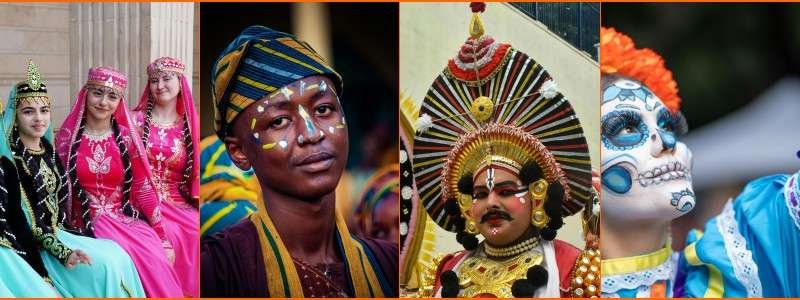
About World Culture Quiz
World culture encompasses the diverse traditions, beliefs, customs, and artistic expressions that define human societies.
From ancient rituals to modern festivals, it reflects shared values and unique identities across continents.
Exploring world culture fosters empathy, understanding, and global connection.
It celebrates humanity’s creativity and resilience through language, food, music, and storytelling. Embracing cultural diversity enriches lives and builds bridges between people everywhere.
Quiz Examples
Some examples of world culture quiz questions:
- Which country is famous for the traditional dance called the Flamenco?
Answer: Spain - What is the traditional Japanese garment called?
Answer: Kimono - In which country did the carnival festival of Rio de Janeiro originate?
Answer: Brazil - Which country is known as the birthplace of pizza and pasta?
Answer: Italy - What is the national musical instrument of Scotland?
Answer: Bagpipes - Which festival marks the end of Ramadan in Islamic culture?
Answer: Eid al-Fitr
How It Works
This quiz features 10 multiple-choice questions with options A to D, randomly selected from our bank of questions. You might be lucky and get more questions from a topic you know well. Remember, the goal here is to test your knowledge!
Time Slot
You have 100 seconds to complete 20 questions. This means you’ll need to race against time and answer each question as quickly and accurately as possible. Goodluck!
World Culture Information.
What is the meaning of world culture?
World culture refers to the shared and diverse traditions, beliefs, customs, arts, languages, and social practices that define human societies globally.
It encompasses both universal human experiences and unique regional expressions, shaped by history, geography, and interaction.
Through festivals, cuisine, music, and storytelling, it builds identity, mutual understanding, and connection across borders, enriching humanity’s collective heritage.
Can I use the quiz for educational purposes?
World culture theory, developed by John W. Meyer, argues that a global culture emerges from shared institutions like education, science, and human rights, promoted by international organizations.
It suggests nation-states adopt similar structures and policies—not just for efficiency, but to gain legitimacy in a rationalized world society. This creates global isomorphism despite local differences.
Is the quiz suitable for all ages?
Yes, the quiz is family-friendly and thoughtfully designed for curious learners of any age, from children to adults. With clear language, engaging topics, and no complex prerequisites, it invites everyone to explore world cultures together, fostering inclusivity, intergenerational learning, and a shared sense of wonder.
What is the purpose of the World Culture Quiz?
The World Culture Quiz aims to test and expand your understanding of global traditions, festivals, customs, and cultural facts in an engaging, interactive format.
By exploring diverse practices from every corner of the globe, it encourages curiosity, promotes cultural awareness, and deepens appreciation for humanity’s shared and unique heritage, making learning both fun and insightful.
What is the world culture theory?
World culture theory, developed by John W. Meyer, argues that a global culture emerges from shared institutions like education, science, and human rights, promoted by international organizations.
It suggests nation-states adopt similar structures and policies—not just for efficiency, but to gain legitimacy in a rationalized world society. This creates global isomorphism despite local differences.
What is the purpose of the World Culture Quiz?
World culture theory, developed by John W. Meyer, argues that a global culture emerges from shared institutions like education, science, and human rights, promoted by international organizations.
It suggests nation-states adopt similar structures and policies—not just for efficiency, but to gain legitimacy in a rationalized world society. This creates global isomorphism despite local differences.