
WORKPLACE MANUAL HANDLING TRAINING QUIZ.
Strengthen your understanding of safe techniques, equipment use, and workplace safety standards.
About This Quiz:
This comprehensive 150-question quiz assesses your knowledge of safe manual handling practices in the workplace. It covers essential topics including proper lifting techniques, risk assessment, the TILE principle, use of mechanical aids, and injury prevention. Complete all questions to evaluate your understanding of workplace manual handling safety standards and best practices.
Manual Handling
Loading...
Loading...
Click the card or tap "Flip Card" to reveal the answer
Workplace Manual Handling Quiz.
50 Questions and Answers
Question 1: What is the maximum weight a person should lift without a risk assessment?
a) 10 kg
b) 15 kg
c) 20 kg
d) There is no specific limit without assessment
Question 2: What does the acronym TILE stand for in manual handling?
a) Task, Individual, Load, Environment
b) Time, Injury, Lift, Evaluate
c) Twist, Impact, Load, Effort
d) Task, Instruction, Load, Equipment
Question 3: Which part of your body should you primarily use when lifting?
a) Your back muscles
b) Your arm muscles
c) Your leg muscles
d) Your shoulder muscles
Question 4: What is the correct position for your feet when lifting a load?
a) Together and parallel
b) Hip-width apart with one foot slightly forward
c) As wide as possible
d) Positioned behind the load
Question 5: When should you twist your spine during lifting?
a) When turning corners
b) When placing items on shelves
c) When reaching for objects
d) Never
Question 6: What is a musculoskeletal disorder (MSD)?
a) A heart condition
b) An injury to muscles, joints, tendons, ligaments, or nerves
c) A respiratory illness
d) A skin condition
Question 7: How close should you keep the load to your body when lifting?
a) At arm's length
b) As close as possible
c) At least 30 cm away
d) It doesn't matter
Question 8: What should you do before lifting any load?
a) Stretch for 10 minutes
b) Assess the load and plan the lift
c) Ask someone to watch
d) Take a deep breath
Question 9: Which of the following is a risk factor for manual handling injuries?
a) Repetitive lifting
b) Awkward postures
c) Heavy loads
d) All of the above
Question 10: What should you do if a load is too heavy to lift safely?
a) Lift it quickly to reduce strain time
b) Use mechanical aids or ask for help
c) Bend your back more to get leverage
d) Hold your breath while lifting
Question 11: What is the kinetic lifting method?
a) Lifting with a curved back
b) Using momentum and body weight to assist lifting
c) Lifting with locked knees
d) Lifting with extended arms
Question 12: How should you position your back when lifting?
a) Rounded and curved
b) Straight and slightly arched
c) Bent at 90 degrees
d) Twisted to the side
Question 13: What percentage of work-related injuries are due to manual handling?
a) Approximately 10%
b) Approximately 20%
c) Approximately 30%
d) Approximately 40%
Question 14: When should a manual handling risk assessment be carried out?
a) Only after an injury occurs
b) Once a year
c) Before any manual handling task is performed
d) Only for heavy items
Question 15: What is the first step in the hierarchy of manual handling control measures?
a) Use mechanical aids
b) Avoid the need for manual handling
c) Train employees
d) Provide protective equipment
Question 16: Which grip is strongest when carrying a load?
a) Fingertip grip
b) Hook grip
c) Full palm grip
d) Pinch grip
Question 17: What should you do when lifting from ground level?
a) Keep legs straight and bend your back
b) Squat down bending your knees
c) Lift with one hand
d) Twist while lifting
Question 18: How often should manual handling training be refreshed?
a) Every 6 months
b) Annually or when tasks change
c) Every 5 years
d) Only once when hired
Question 19: What is the neutral spine position?
a) A completely flat back
b) The natural curve of the spine
c) A rounded back position
d) An arched back position
Question 20: Which of these is an example of a mechanical aid for manual handling?
a) Trolley
b) Hoist
c) Conveyor belt
d) All of the above
Question 21: What should you wear when performing manual handling tasks?
a) Loose, baggy clothing
b) High heels or flip-flops
c) Appropriate footwear and fitted clothing
d) Multiple layers regardless of temperature
Question 22: What is the recommended technique for lowering a load?
a) Drop it quickly
b) Use the same principles as lifting in reverse
c) Bend at the waist
d) Lower it with straight legs
Question 23: When is team lifting required?
a) When the load is awkwardly shaped
b) When the load is too heavy for one person
c) When the route is obstructed
d) All of the above
Question 24: What does PPE stand for in workplace safety?
a) Personal Protection Equipment
b) Personal Protective Equipment
c) Primary Protection Equipment
d) Preventive Protective Equipment
Question 25: How should you carry a load up stairs?
a) Lean backward for balance
b) Take two steps at a time
c) Keep the load stable and take one step at a time
d) Run up quickly
Question 26: What is the danger zone when lifting?
a) Below knee height and above shoulder height
b) At waist height
c) At chest height
d) At hip height
Question 27: Which factor is part of the 'Individual' aspect of TILE?
a) Temperature of the environment
b) Physical capability and training
c) Weight of the load
d) Distance to be carried
Question 28: What should you do if you feel pain during lifting?
a) Continue and finish the job
b) Stop immediately and report it
c) Take pain medication and continue
d) Ignore it if it's minor
Question 29: How can you reduce the risk of injury when pushing or pulling?
a) Use your back muscles
b) Keep arms extended fully
c) Use your body weight and keep arms bent
d) Push with one hand only
Question 30: What is dynamic risk assessment?
a) A written document
b) An ongoing evaluation of risks as the task progresses
c) A one-time assessment
d) A computer program
Question 31: Which environmental factor can increase manual handling risks?
a) Poor lighting
b) Slippery floors
c) Confined spaces
d) All of the above
Question 32: What is the correct breathing technique when lifting?
a) Hold your breath throughout the lift
b) Breathe out during the lift
c) Breathe in deeply and hold
d) Hyperventilate before lifting
Question 33: When should gloves be worn during manual handling?
a) Always, regardless of the task
b) When handling sharp, hot, or rough objects
c) Never, as they reduce grip
d) Only in cold weather
Question 34: What is a manual handling injury often referred to as?
a) Acute injury
b) Cumulative trauma disorder
c) Overexertion injury
d) All of the above
Question 35: How should you test the weight of a load before lifting?
a) Try to lift it with one hand first
b) Gently push or tilt it to gauge weight
c) Ask someone else to lift it first
d) Just lift it and see
Question 36: What is the recommended method for carrying loads long distances?
a) Hold at arm's length
b) Use mechanical aids or take rest breaks
c) Run to complete it faster
d) Carry as much as possible at once
Question 37: Which of the following indicates a load may be unstable?
a) Liquid contents
b) Uneven weight distribution
c) Contents shifting during movement
d) All of the above
Question 38: What should you do when working in a confined space while manual handling?
a) Work as quickly as possible
b) Assess risks and use appropriate techniques
c) Ignore normal lifting procedures
d) Always work alone
Question 39: How can repetitive manual handling tasks cause injury?
a) Through cumulative strain over time
b) By causing sudden acute injuries only
c) They cannot cause injury
d) Only if done incorrectly once
Question 40: What is the purpose of manual handling training?
a) To meet legal requirements only
b) To reduce injuries and improve techniques
c) To test employee strength
d) To assign blame when injuries occur
Question 41: When should you report manual handling hazards?
a) Only after someone is injured
b) At the annual safety meeting
c) Immediately when identified
d) Never
Question 42: What does ergonomics mean in manual handling?
a) The study of workplace design
b) Designing tasks to fit human capabilities
c) Exercise routines for workers
d) The weight of objects
Question 43: Which of the following is a warning sign of potential injury?
a) Persistent discomfort or pain
b) Tingling or numbness
c) Reduced grip strength
d) All of the above
Question 44: How should you handle loads with sharp edges?
a) Use bare hands for better grip
b) Wear appropriate gloves and use caution
c) Ignore the sharp edges
d) Always refuse to handle them
Question 45: What is the correct way to change direction while carrying a load?
a) Twist your spine
b) Move your feet and turn your whole body
c) Pivot on one foot
d) Bend sideways
Question 46: When lifting as a team, what is most important?
a) Speed of movement
b) Communication and coordination
c) Each person lifting different amounts
d) Competition
Question 47: What should be included in a manual handling risk assessment?
a) Only the weight of the load
b) Task, Individual, Load & Environment factors
c) Just the distance to be moved
d) Only previous injury records
Question 48: How can you reduce the load weight if it's too heavy?
a) Lift it anyway but quickly
b) Break it into smaller loads or get help
c) Use only one hand
d) Bend your back more
Question 49: What is the role of supervision in manual handling safety?
a) To blame workers
b) To monitor compliance and provide guidance
c) To lift loads for workers
d) Not necessary
Question 50: Why is it important to keep walkways clear during manual handling?
a) It looks more professional
b) To prevent trips, slips, and falls
c) To save space
d) It's not important
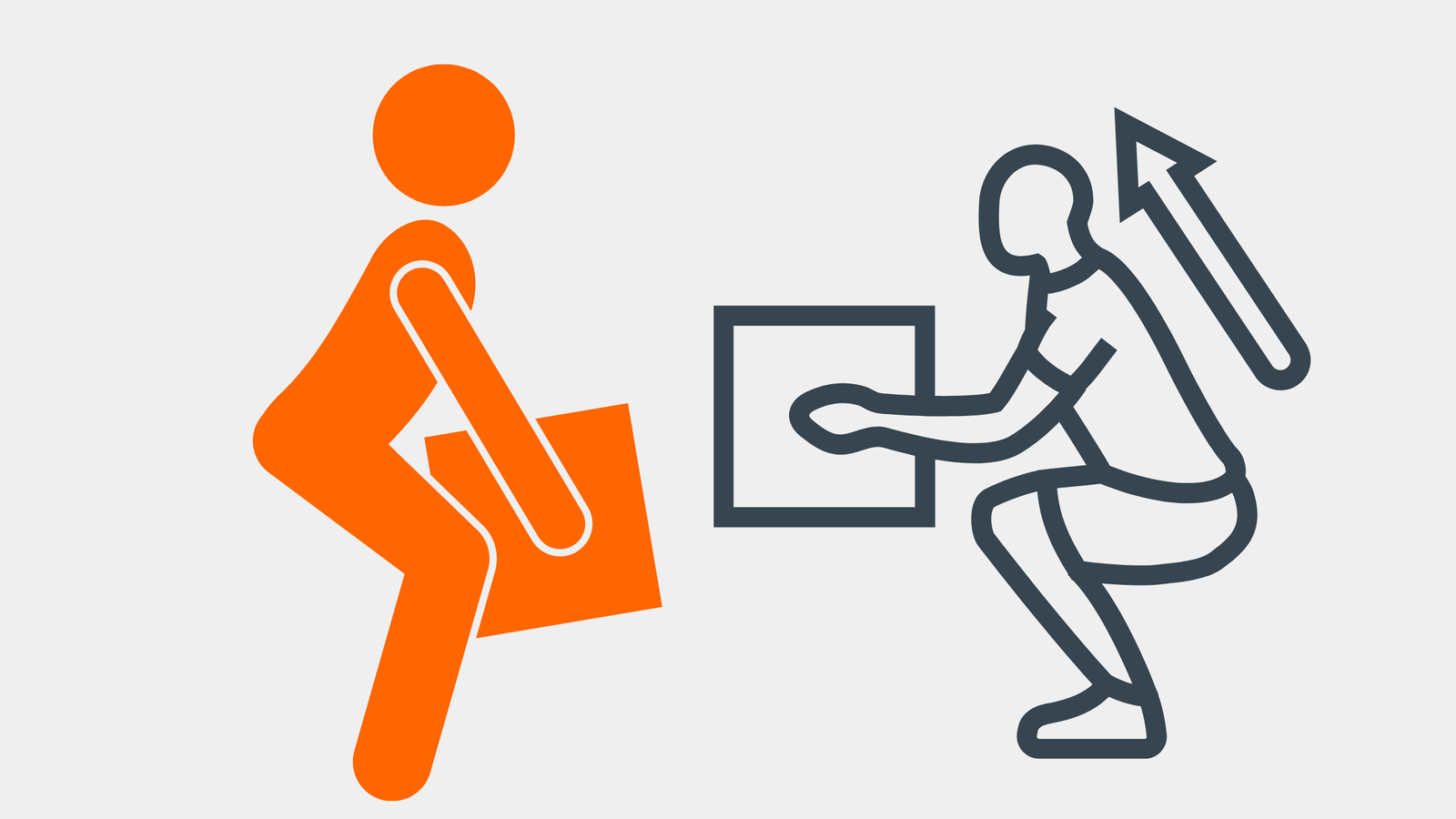
MANUAL HANDLING ANSWER KEY
- d) There is no specific limit without assessment
- a) Task, Individual, Load, Environment
- c) Your leg muscles
- b) Hip-width apart with one foot slightly forward
- d) Never
- b) An injury to muscles, joints, tendons, ligaments, or nerves
- b) As close as possible
- b) Assess the load and plan the lift
- d) All of the above
- b) Use mechanical aids or ask for help
- b) Using momentum and body weight to assist lifting
- b) Straight and slightly arched
- c) Approximately 30%
- c) Before any manual handling task is performed
- b) Avoid the need for manual handling
- c) Full palm grip
- b) Squat down bending your knees
- b) Annually or when tasks change
- b) The natural curve of the spine
- d) All of the above
- c) Appropriate footwear and fitted clothing
- b) Use the same principles as lifting in reverse
- d) All of the above
- b) Personal Protective Equipment
- c) Keep the load stable and take one step at a time
- a) Below knee height and above shoulder height
- b) Physical capability and training
- b) Stop immediately and report it
- c) Use your body weight and keep arms bent
- b) An ongoing evaluation of risks as the task progresses
- d) All of the above
- b) Breathe out during the lift
- b) When handling sharp, hot, or rough objects
- d) All of the above
- b) Gently push or tilt it to gauge weight
- b) Use mechanical aids or take rest breaks
- d) All of the above
- b) Assess risks and use appropriate techniques
- a) Through cumulative strain over time
- b) To reduce injuries and improve techniques
- c) Immediately when identified
- b) Designing tasks to fit human capabilities
- d) All of the above
- b) Wear appropriate gloves and use caution
- b) Move your feet and turn your whole body
- b) Communication and coordination
- b) Task, Individual, Load, and Environment factors
- b) Break it into smaller loads or get help
- b) To monitor compliance and provide guidance
- b) To prevent trips, slips, and falls while carrying loads
QUESTIONS 51–100
Question 51. What is the maximum weight a person should lift without a risk assessment?
a) 10 kg
b) 15 kg
c) 20 kg
d) There is no specific limit without assessment
Question 52. What does the acronym TILE stand for in manual handling?
a) Task, Individual, Load, Environment
b) Time, Injury, Lift, Evaluate
c) Twist, Impact, Load, Effort
d) Task, Instruction, Load, Equipment
Question 53. Which part of your body should you primarily use when lifting?
a) Your back muscles
b) Your arm muscles
c) Your leg muscles
d) Your shoulder muscles
Question 54. What is the correct position for your feet when lifting a load?
a) Together and parallel
b) Hip-width apart with one foot slightly forward
c) As wide as possible
d) Positioned behind the load
Question 55. When should you twist your spine during lifting?
a) When turning corners
b) When placing items on shelves
c) When reaching for objects
d) Never
Question 56. What is a musculoskeletal disorder (MSD)?
a) A heart condition
b) An injury to muscles, joints, tendons, ligaments, or nerves
c) A respiratory illness
d) A skin condition
Question 57. How close should you keep the load to your body when lifting?
a) At arm's length
b) As close as possible
c) At least 30 cm away
d) It doesn't matter
Question 58. What should you do before lifting any load?
a) Stretch for 10 minutes
b) Assess the load and plan the lift
c) Ask someone to watch
d) Take a deep breath
Question 59. Which of the following is a risk factor for manual handling injuries?
a) Repetitive lifting
b) Awkward postures
c) Heavy loads
d) All of the above
Question 60. What should you do if a load is too heavy to lift safely?
a) Lift it quickly to reduce strain time
b) Use mechanical aids or ask for help
c) Bend your back more to get leverage
d) Hold your breath while lifting
Question 61. What is the kinetic lifting method?
a) Lifting with a curved back
b) Using momentum and body weight to assist lifting
c) Lifting with locked knees
d) Lifting with extended arms
Question 62. How should you position your back when lifting?
a) Rounded and curved
b) Straight and slightly arched
c) Bent at 90 degrees
d) Twisted to the side
Question 63. What percentage of work-related injuries are due to manual handling?
a) Approximately 10%
b) Approximately 20%
c) Approximately 30%
d) Approximately 40%
Question 64. When should a manual handling risk assessment be carried out?
a) Only after an injury occurs
b) Once a year
c) Before any manual handling task is performed
d) Only for heavy items
Question 65. What is the first step in the hierarchy of manual handling control measures?
a) Use mechanical aids
b) Avoid the need for manual handling
c) Train employees
d) Provide protective equipment
Question 66. Which grip is strongest when carrying a load?
a) Fingertip grip
b) Hook grip
c) Full palm grip
d) Pinch grip
Question 67. What should you do when lifting from ground level?
a) Keep legs straight and bend your back
b) Squat down bending your knees
c) Lift with one hand
d) Twist while lifting
Question 68. How often should manual handling training be refreshed?
a) Every 6 months
b) Annually or when tasks change
c) Every 5 years
d) Only once when hired
Question 69. What is the neutral spine position?
a) A completely flat back
b) The natural curve of the spine
c) A rounded back position
d) An arched back position
Question 70. Which of these is an example of a mechanical aid for manual handling?
a) Trolley
b) Hoist
c) Conveyor belt
d) All of the above
Question 71. What should you wear when performing manual handling tasks?
a) Loose, baggy clothing
b) High heels or flip-flops
c) Appropriate footwear and fitted clothing
d) Multiple layers regardless of temperature
Question 72. What is the recommended technique for lowering a load?
a) Drop it quickly
b) Use the same principles as lifting in reverse
c) Bend at the waist
d) Lower it with straight legs
Question 73. When is team lifting required?
a) When the load is awkwardly shaped
b) When the load is too heavy for one person
c) When the route is obstructed
d) All of the above
Question 74. What does PPE stand for in workplace safety?
a) Personal Protection Equipment
b) Personal Protective Equipment
c) Primary Protection Equipment
d) Preventive Protective Equipment
Question 75. How should you carry a load up stairs?
a) Lean backward for balance
b) Take two steps at a time
c) Keep the load stable and take one step at a time
d) Run up quickly
Question 76. What is the danger zone when lifting?
a) Below knee height and above shoulder height
b) At waist height
c) At chest height
d) At hip height
Question 77. Which factor is part of the 'Individual' aspect of TILE?
a) Temperature of the environment
b) Physical capability and training
c) Weight of the load
d) Distance to be carried
Question 78. What should you do if you feel pain during lifting?
a) Continue and finish the job
b) Stop immediately and report it
c) Take pain medication and continue
d) Ignore it if it's minor
Question 79. How can you reduce the risk of injury when pushing or pulling?
a) Use your back muscles
b) Keep arms extended fully
c) Use your body weight and keep arms bent
d) Push with one hand only
Question 80. What is dynamic risk assessment?
a) A written document
b) An ongoing evaluation of risks as the task progresses
c) A one-time assessment
d) A computer program
Question 81. Which environmental factor can increase manual handling risks?
a) Poor lighting
b) Slippery floors
c) Confined spaces
d) All of the above
Question 82. What is the correct breathing technique when lifting?
a) Hold your breath throughout the lift
b) Breathe out during the lift
c) Breathe in deeply and hold
d) Hyperventilate before lifting
Question 83. When should gloves be worn during manual handling?
a) Always
b) When handling sharp, hot, or rough objects
c) Never
d) Only in cold weather
Question 84. What is a manual handling injury often referred to as?
a) Acute injury
b) Cumulative trauma disorder
c) Overexertion injury
d) All of the above
Question 85. How should you test the weight of a load before lifting?
a) Try to lift it with one hand first
b) Gently push or tilt it to gauge weight
c) Ask someone else to lift it first
d) Just lift it and see what happens
Question 86. What is the recommended method for carrying loads long distances?
a) Hold at arm's length
b) Use mechanical aids or take rest breaks
c) Run to complete it faster
d) Carry as much as possible at once
Question 87. Which of the following indicates a load may be unstable?
a) Liquid contents
b) Uneven weight distribution
c) Contents shifting during movement
d) All of the above
Question 88. What should you do when working in a confined space while manual handling?
a) Work as quickly as possible
b) Assess risks and use appropriate techniques
c) Ignore normal lifting procedures
d) Always work alone
Question 89. How can repetitive manual handling tasks cause injury?
a) Through cumulative strain over time
b) By causing sudden acute injuries only
c) They cannot cause injury
d) Only if done incorrectly once
Question 90. What is the purpose of manual handling training?
a) To meet legal requirements only
b) To reduce injuries and improve techniques
c) To test employee strength
d) To assign blame when injuries occur
Question 91. When should you report manual handling hazards?
a) Only after someone is injured
b) At the annual safety meeting
c) Immediately when identified
d) Never
Question 92. What does ergonomics mean in manual handling?
a) The study of workplace design
b) Designing tasks to fit human capabilities
c) Exercise routines for workers
d) The weight of objects
Question 93. Which of the following is a warning sign of potential injury?
a) Persistent discomfort or pain
b) Tingling or numbness
c) Reduced grip strength
d) All of the above
Question 94. How should you handle loads with sharp edges?
a) Use bare hands for better grip
b) Wear appropriate gloves and use caution
c) Ignore the sharp edges
d) Always refuse to handle them
Question 95. What is the correct way to change direction while carrying a load?
a) Twist your spine
b) Move your feet and turn your whole body
c) Pivot on one foot
d) Bend sideways
Question 96. When lifting as a team, what is most important?
a) Speed of movement
b) Communication and coordination
c) Each person lifting different amounts
d) Competition
Question 97. What should be included in a manual handling risk assessment?
a) Only the weight of the load
b) Task, Individual, Load, and Environment factors
c) Just the distance to be moved
d) Only previous injury records
Question 98. How can you reduce the load weight if it's too heavy?
a) Lift it anyway but quickly
b) Break it into smaller loads or get help
c) Use only one hand
d) Bend your back more
Question 99. What is the role of supervision in manual handling safety?
a) To blame workers for injuries
b) To monitor compliance and provide guidance
c) To lift loads for workers
d) Supervision is not necessary
Question 100. Why is it important to keep walkways clear during manual handling?
a) It looks more professional
b) To prevent trips, slips, and falls while carrying loads
c) To save space
d) It's not important
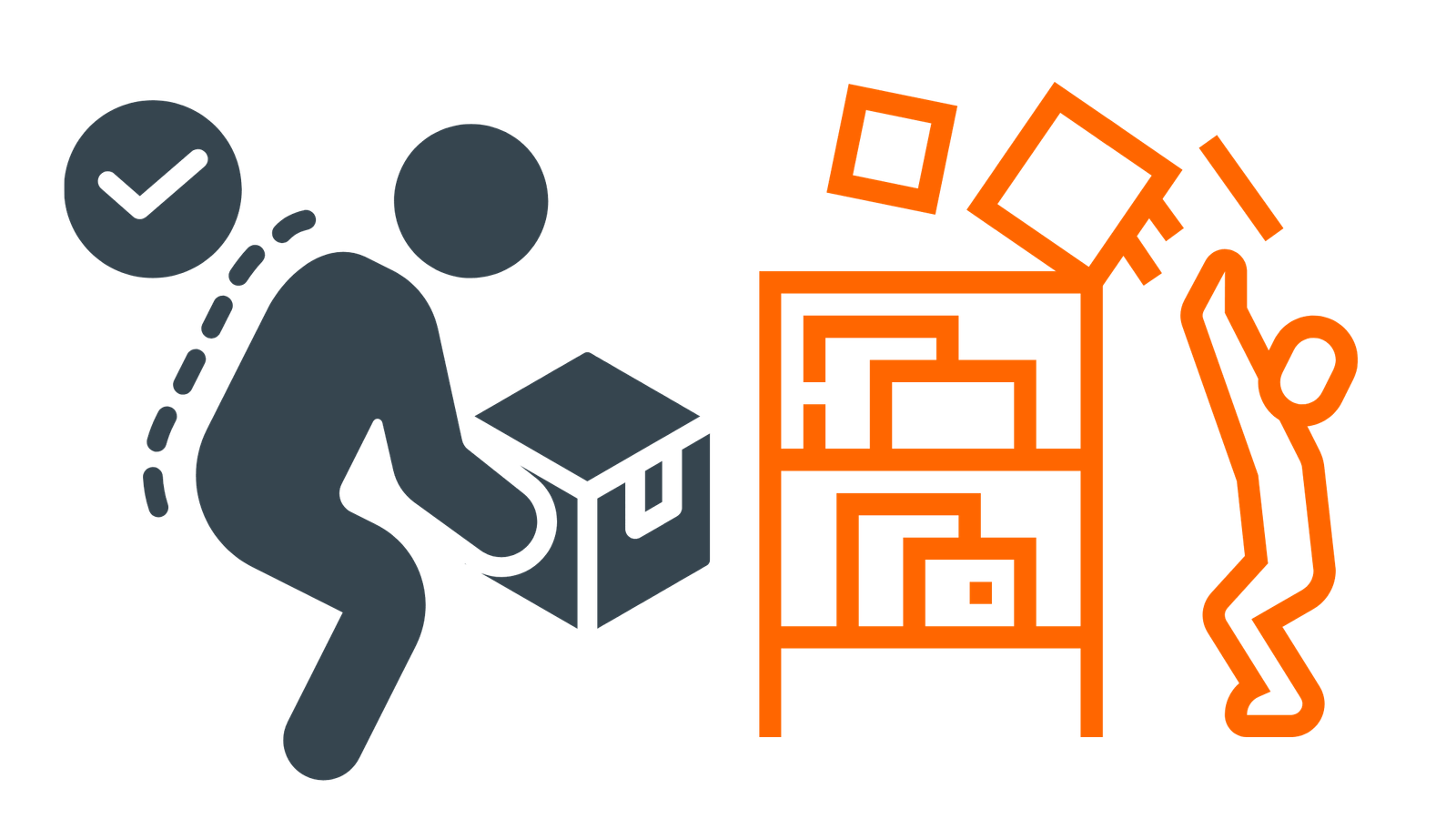
Manual Handling ANSWER KEY (51-100 Quiz Answers)
- d) There is no specific limit without assessment
- a) Task, Individual, Load, Environment
- c) Your leg muscles
- b) Hip-width apart with one foot slightly forward
- d) Never
- b) An injury to muscles, joints, tendons, ligaments, or nerves
- b) As close as possible
- b) Assess the load and plan the lift
- d) All of the above
- b) Use mechanical aids or ask for help
- b) Using momentum and body weight to assist lifting
- b) Straight and slightly arched
- c) Approximately 30%
- c) Before any manual handling task is performed
- b) Avoid the need for manual handling
- c) Full palm grip
- b) Squat down bending your knees
- b) Annually or when tasks change
- b) The natural curve of the spine
- d) All of the above
- c) Appropriate footwear and fitted clothing
- b) Use the same principles as lifting in reverse
- d) All of the above
- b) Personal Protective Equipment
- c) Keep the load stable and take one step at a time
- a) Below knee height and above shoulder height
- b) Physical capability and training
- b) Stop immediately and report it
- c) Use your body weight and keep arms bent
- b) An ongoing evaluation of risks as the task progresses
- d) All of the above
- b) Breathe out during the lift
- b) When handling sharp, hot, or rough objects
- d) All of the above
- b) Gently push or tilt it to gauge weight
- b) Use mechanical aids or take rest breaks
- d) All of the above
- b) Assess risks and use appropriate techniques
- a) Through cumulative strain over time
- b) To reduce injuries and improve techniques
- c) Immediately when identified
- b) Designing tasks to fit human capabilities
- d) All of the above
- b) Wear appropriate gloves and use caution
- b) Move your feet and turn your whole body
- b) Communication and coordination
- b) Task, Individual, Load, and Environment factors
- b) Break it into smaller loads or get help
- b) To monitor compliance and provide guidance
- b) To prevent trips, slips, and falls while carrying loads
Workplace Manual Handling Quiz.
QUESTIONS
Question 101: What is the maximum weight a person should lift without a risk assessment?
a) 10 kg
b) 15 kg
c) 20 kg
d) There is no specific limit without assessment
Question 102: What does the acronym TILE stand for in manual handling?
a) Task, Individual, Load, Environment
b) Time, Injury, Lift, Evaluate
c) Twist, Impact, Load, Effort
d) Task, Instruction, Load, Equipment
Question 103: Which part of your body should you primarily use when lifting?
a) Your back muscles
b) Your arm muscles
c) Your leg muscles
d) Your shoulder muscles
Question 104: What is the correct position for your feet when lifting a load?
a) Together and parallel
b) Hip-width apart with one foot slightly forward
c) As wide as possible
d) Positioned behind the load
Question 105: When should you twist your spine during lifting?
a) When turning corners
b) When placing items on shelves
c) When reaching for objects
d) Never
Question 106: What is a musculoskeletal disorder (MSD)?
a) A heart condition
b) An injury to muscles, joints, tendons, ligaments, or nerves
c) A respiratory illness
d) A skin condition
Question 107: How close should you keep the load to your body when lifting?
a) At arm's length
b) As close as possible
c) At least 30 cm away
d) It doesn't matter
Question 108: What should you do before lifting any load?
a) Stretch for 10 minutes
b) Assess the load and plan the lift
c) Ask someone to watch
d) Take a deep breath
Question 109: Which of the following is a risk factor for manual handling injuries?
a) Repetitive lifting
b) Awkward postures
c) Heavy loads
d) All of the above
Question 110: What should you do if a load is too heavy to lift safely?
a) Lift it quickly to reduce strain time
b) Use mechanical aids or ask for help
c) Bend your back more to get leverage
d) Hold your breath while lifting
Question 111: What is the kinetic lifting method?
a) Lifting with a curved back
b) Using momentum and body weight to assist lifting
c) Lifting with locked knees
d) Lifting with extended arms
Question 112: How should you position your back when lifting?
a) Rounded and curved
b) Straight and slightly arched
c) Bent at 90 degrees
d) Twisted to the side
Question 113: What percentage of work-related injuries are due to manual handling?
a) Approximately 10%
b) Approximately 20%
c) Approximately 30%
d) Approximately 40%
Question 114: When should a manual handling risk assessment be carried out?
a) Only after an injury occurs
b) Once a year
c) Before any manual handling task is performed
d) Only for heavy items
Question 115: What is the first step in the hierarchy of manual handling control measures?
a) Use mechanical aids
b) Avoid the need for manual handling
c) Train employees
d) Provide protective equipment
Question 116: Which grip is strongest when carrying a load?
a) Fingertip grip
b) Hook grip
c) Full palm grip
d) Pinch grip
Question 117: What should you do when lifting from ground level?
a) Keep legs straight and bend your back
b) Squat down bending your knees
c) Lift with one hand
d) Twist while lifting
Question 118: How often should manual handling training be refreshed?
a) Every 6 months
b) Annually or when tasks change
c) Every 5 years
d) Only once when hired
Question 119: What is the neutral spine position?
a) A completely flat back
b) The natural curve of the spine
c) A rounded back position
d) An arched back position
Question 120: Which of these is an example of a mechanical aid for manual handling?
a) Trolley
b) Hoist
c) Conveyor belt
d) All of the above
Question 121: What should you wear when performing manual handling tasks?
a) Loose, baggy clothing
b) High heels or flip-flops
c) Appropriate footwear and fitted clothing
d) Multiple layers regardless of temperature
Question 122: What is the recommended technique for lowering a load?
a) Drop it quickly
b) Use the same principles as lifting in reverse
c) Bend at the waist
d) Lower it with straight legs
Question 123: When is team lifting required?
a) When the load is awkwardly shaped
b) When the load is too heavy for one person
c) When the route is obstructed
d) All of the above
Question 124: What does PPE stand for in workplace safety?
a) Personal Protection Equipment
b) Personal Protective Equipment
c) Primary Protection Equipment
d) Preventive Protective Equipment
Question 125: How should you carry a load up stairs?
a) Lean backward for balance
b) Take two steps at a time
c) Keep the load stable and take one step at a time
d) Run up quickly
Question 126: What is the danger zone when lifting?
a) Below knee height and above shoulder height
b) At waist height
c) At chest height
d) At hip height
Question 127: Which factor is part of the 'Individual' aspect of TILE?
a) Temperature of the environment
b) Physical capability and training
c) Weight of the load
d) Distance to be carried
Question 128: What should you do if you feel pain during lifting?
a) Continue and finish the job
b) Stop immediately and report it
c) Take pain medication and continue
d) Ignore it if it's minor
Question 129: How can you reduce the risk of injury when pushing or pulling?
a) Use your back muscles
b) Keep arms extended fully
c) Use your body weight and keep arms bent
d) Push with one hand only
Question 130: What is dynamic risk assessment?
a) A written document
b) An ongoing evaluation of risks as the task progresses
c) A one-time assessment
d) A computer program
Question 131: Which environmental factor can increase manual handling risks?
a) Poor lighting
b) Slippery floors
c) Confined spaces
d) All of the above
Question 132: What is the correct breathing technique when lifting?
a) Hold your breath throughout the lift
b) Breathe out during the lift
c) Breathe in deeply and hold
d) Hyperventilate before lifting
Question 133: When should gloves be worn during manual handling?
a) Always, regardless of the task
b) When handling sharp, hot, or rough objects
c) Never, as they reduce grip
d) Only in cold weather
Question 134: What is a manual handling injury often referred to as?
a) Acute injury
b) Cumulative trauma disorder
c) Overexertion injury
d) All of the above
Question 135: How should you test the weight of a load before lifting?
a) Try to lift it with one hand first
b) Gently push or tilt it to gauge weight
c) Ask someone else to lift it first
d) Just lift it and see
Question 136: What is the recommended method for carrying loads long distances?
a) Hold at arm's length
b) Use mechanical aids or take rest breaks
c) Run to complete it faster
d) Carry as much as possible at once
Question 137: Which of the following indicates a load may be unstable?
a) Liquid contents
b) Uneven weight distribution
c) Contents shifting during movement
d) All of the above
Question 138: What should you do when working in a confined space while manual handling?
a) Work as quickly as possible
b) Assess risks and use appropriate techniques
c) Ignore normal lifting procedures
d) Always work alone
Question 139: How can repetitive manual handling tasks cause injury?
a) Through cumulative strain over time
b) By causing sudden acute injuries only
c) They cannot cause injury
d) Only if done incorrectly once
Question 140: What is the purpose of manual handling training?
a) To meet legal requirements only
b) To reduce injuries and improve techniques
c) To test employee strength
d) To assign blame when injuries occur
Question 141: When should you report manual handling hazards?
a) Only after someone is injured
b) At the annual safety meeting
c) Immediately when identified
d) Never
Question 142: What does ergonomics mean in manual handling?
a) The study of workplace design
b) Designing tasks to fit human capabilities
c) Exercise routines for workers
d) The weight of objects
Question 143: Which of the following is a warning sign of potential injury?
a) Persistent discomfort or pain
b) Tingling or numbness
c) Reduced grip strength
d) All of the above
Question 144: How should you handle loads with sharp edges?
a) Use bare hands for better grip
b) Wear appropriate gloves and use caution
c) Ignore the sharp edges
d) Always refuse to handle them
Question 145: What is the correct way to change direction while carrying a load?
a) Twist your spine
b) Move your feet and turn your whole body
c) Pivot on one foot
d) Bend sideways
Question 146: When lifting as a team, what is most important?
a) Speed of movement
b) Communication and coordination
c) Each person lifting different amounts
d) Competition
Question 147: What should be included in a manual handling risk assessment?
a) Only the weight of the load
b) Task, Individual, Load & Environment factors
c) Just the distance to be moved
d) Only previous injury records
Question 148: How can you reduce the load weight if it's too heavy?
a) Lift it anyway but quickly
b) Break it into smaller loads or get help
c) Use only one hand
d) Bend your back more
Question 149: What is the role of supervision in manual handling safety?
a) To blame workers
b) To monitor compliance and provide guidance
c) To lift loads for workers
d) Not necessary
Question 150: Why is it important to keep walkways clear during manual handling?
a) It looks more professional
b) To prevent trips, slips, and falls
c) To save space
d) It's not important
Workplace Manual Handling ANSWER KEY:
- d) There is no specific limit without assessment
- a) Task, Individual, Load, Environment
- c) Your leg muscles
- b) Hip-width apart with one foot slightly forward
- d) Never
- b) An injury to muscles, joints, tendons, ligaments, or nerves
- b) As close as possible
- b) Assess the load and plan the lift
- d) All of the above
- b) Use mechanical aids or ask for help
- b) Using momentum and body weight to assist lifting
- b) Straight and slightly arched
- c) Approximately 30%
- c) Before any manual handling task is performed
- b) Avoid the need for manual handling
- c) Full palm grip
- b) Squat down bending your knees
- b) Annually or when tasks change
- b) The natural curve of the spine
- d) All of the above
- c) Appropriate footwear and fitted clothing
- b) Use the same principles as lifting in reverse
- d) All of the above
- b) Personal Protective Equipment
- c) Keep the load stable and take one step at a time
- a) Below knee height and above shoulder height
- b) Physical capability and training
- b) Stop immediately and report it
- c) Use your body weight and keep arms bent
- b) An ongoing evaluation of risks as the task progresses
- d) All of the above
- b) Breathe out during the lift
- b) When handling sharp, hot, or rough objects
- d) All of the above
- b) Gently push or tilt it to gauge weight
- b) Use mechanical aids or take rest breaks
- d) All of the above
- b) Assess risks and use appropriate techniques
- a) Through cumulative strain over time
- b) To reduce injuries and improve techniques
- c) Immediately when identified
- b) Designing tasks to fit human capabilities
- d) All of the above
- b) Wear appropriate gloves and use caution
- b) Move your feet and turn your whole body
- b) Communication and coordination
- b) Task, Individual, Load & Environment factors
- b) Break it into smaller loads or get help
- b) To monitor compliance and provide guidance
- b) To prevent trips, slips, and falls