
The Role of the Responsible Person in Fire Safety: Legal Duties and Best Practices
Fire safety is a critical aspect of managing any workplace or non-domestic building.
The "Responsible Person" (RP) in fire safety is the individual or organization with overall legal duties for fire safety in a workplace or non-domestic building, typically the employer, owner, landlord, or building manager.
Their key tasks include conducting fire risk assessments, implementing safety measures, creating emergency plans, informing occupants, and providing training to ensure compliance with laws like the Regulatory Reform (Fire Safety) Order 2005.
Who Is the Responsible Person?
The term “Responsible Person” is defined under the Regulatory Reform (Fire Safety) Order 2005 (FSO). In simple terms, the RP is the person or entity with overall control of a building or premises. This typically includes:
- Employers: In a workplace setting, the employer is usually the RP.
- Owners or Landlords: For non-domestic premises, such as offices, retail spaces, or blocks of flats.
- Occupiers or Controllers: Anyone with significant control, such as a building manager, managing agent, or facilities manager.
- Providers of Accommodation: Those running B&Bs, guesthouses, or self-catering properties.
In multi-occupied buildings, there may be multiple Responsible Persons, and the law requires them to collaborate to ensure comprehensive fire safety measures are in place.
Key Definition: Article 3 (FSO)
Under Article 3 of the FSO, the "Responsible Person" of a premises (either a building or any part of it) is defined as the person who has control of the premises. This allows for a broad scope of responsibility, which may include:
- Building Owners
- Leaseholders
- Building Managers
✅You can try our fire safety quiz for free, with more questions available on the page.
Legal Framework
The Fire Safety Responsible Person's duties are primarily governed by:
- Regulatory Reform (Fire Safety) Order 2005 (FSO): The cornerstone legislation for fire safety in England and Wales, applying to all non-domestic premises and communal areas of residential buildings.
- Fire Safety Act 2021: Expanded the scope of the FSO to include external walls, structure, and flat entrance doors in multi-occupied residential buildings.
- Fire Safety (England) Regulations 2022: Introduced additional requirements for high-rise and multi-occupancy buildings, such as providing evacuation plans for vulnerable residents.
In essence, if you have control over a business premises or a building with multiple domestic units, you are likely the Responsible Person and must ensure compliance with these laws.
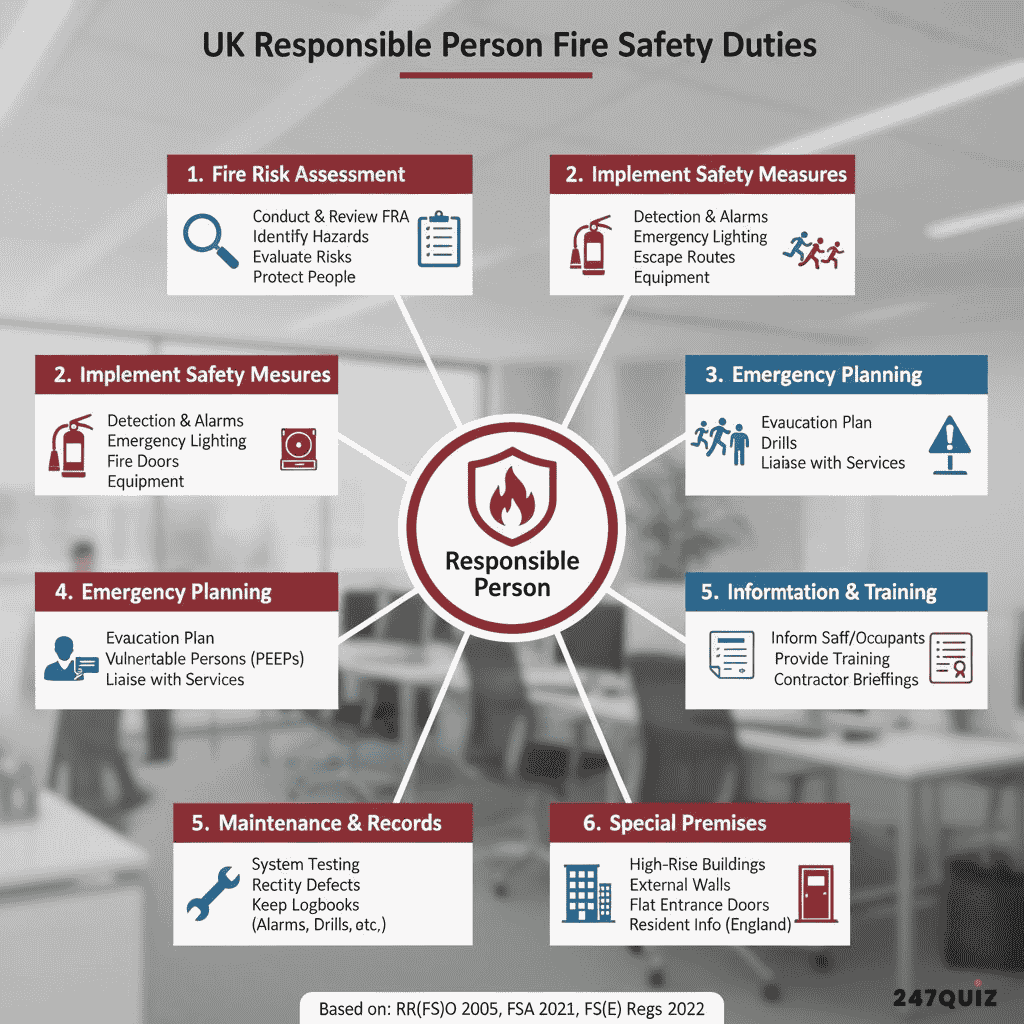
Key Responsibilities of the Responsible Person
The RP’s duties can be grouped into several core areas:
Fire Risk Assessment
The RP must carry out a suitable and sufficient fire risk assessment to identify hazards, evaluate risks, and determine necessary precautions. This assessment should be:
- Documented (mandatory for businesses with five or more employees).
- Reviewed regularly, especially after significant changes to the building or its use.
Responsible Person Checklist
Risk Assessment Steps
- 1. Identify Hazards: Sources of ignition, fuel, oxygen.
- 2. Identify People: Staff, visitors, vulnerable individuals.
- 3. Evaluate: Assess risks and existing safety measures.
- 4. Escape Routes: Ensure they are clear and accessible.
- 5. Alarms: Check detection and alarm systems.
- 6. Equipment: Confirm fire-fighting equipment suitability.
- 7. Training: Provide staff with safety training.
- 8. Review: Record findings and review regularly.
Fire Safety Measures
Implement and maintain appropriate fire safety precautions, including:
- Fire detection and alarm systems.
- Fire-fighting equipment such as extinguishers.
- Safe means of escape, clearly marked and unobstructed.
Emergency Planning
Develop and maintain an emergency plan detailing:
- Evacuation procedures.
- Assembly points.
- Roles and responsibilities during an emergency.
For buildings with vulnerable occupants, Personal Emergency Evacuation Plans (PEEPs) should be prepared.
Responsible Person Duties
Fire Safety Emergency Plan
- 1. Raise the Alarm: Establish a clear procedure for activation.
- 2. Routes & Exits: Clearly identify evacuation paths.
- 3. Assembly Point: Define a safe meeting location.
- 4. Roles Assigned: Designate fire wardens and responsibilities.
- 5. Vulnerable Persons: Detail specific support arrangements.
- 6. Emergency Services: Document procedures for contacting 999.
- 7. Equipment: Note location of fire-fighting gear.
- 8. Review: Conduct regular drills and plan updates.
Information and Training
The RP must:
- Inform staff and occupants about fire risks and safety measures.
- Provide regular fire safety training, including drills and instruction on using fire-fighting equipment.
Collaboration
Where multiple Fire Safety Responsible Persons exist (e.g., in shared premises), they must work together to ensure all duties are fulfilled without gaps or overlaps.
Documentation and Competence
Maintain records of:
- Fire risk assessments.
- Maintenance checks for alarms, extinguishers, and emergency lighting.
- Training sessions and evacuation drills.
Appoint competent persons to assist with fire safety tasks, such as risk assessments and equipment maintenance.
Consequences of Non-Compliance
Failure to meet legal obligations can result in:
- Enforcement notices from fire authorities.
- Civil liability if harm occurs due to negligence.
- Criminal prosecution, leading to fines or imprisonment.
These penalties underscore the importance of proactive compliance.
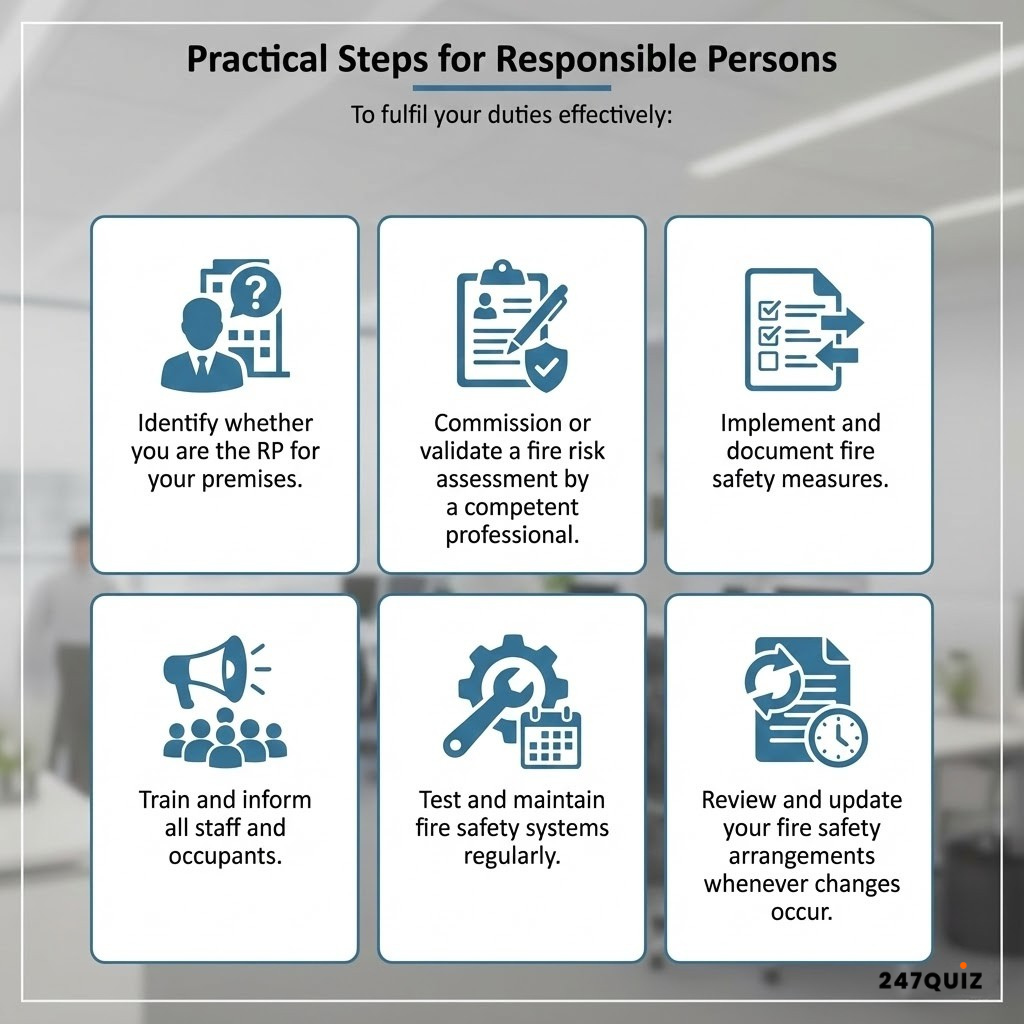
Practical Steps for Responsible Persons
To fulfil your duties effectively:
- Identify whether you are the RP for your premises.
- Commission or validate a fire risk assessment by a competent professional.
- Implement and document fire safety measures.
- Train and inform all staff and occupants.
- Test and maintain fire safety systems regularly.
- Review and update your fire safety arrangements whenever changes occur.
Key Responsibilities of the Responsible Person
The RP’s duties can be grouped into several core areas:
Fire Safety Responsible Person Checklist
1. Daily Checks
- Fire exits are unlocked, unobstructed, and clearly marked
- Escape routes are clear of obstacles and hazards
- Fire doors close properly and are not wedged open
- Exit signs and emergency lighting are functioning
- No obvious fire hazards (overloaded sockets, damaged electrical equipment)
2. Weekly Checks
- Fire alarm call points are accessible and unobstructed
- Fire extinguishers are in place, undamaged, and accessible
- Emergency lighting test (brief function check)
- Fire assembly point is clear and accessible
- Review any maintenance or repair issues logged
3. Monthly Checks
- Fire alarm system test (activate at different call point each month)
- Emergency lighting full duration test (monthly or as per manufacturer guidance)
- Fire extinguisher visual inspection (check pressure gauges, seals, signs of damage)
- Fire safety signage is clean, visible, and in good condition
- Housekeeping standards maintained in all areas
4. Quarterly Checks
- Review fire risk assessment and update if necessary
- Check staff training records are up to date
- Review fire evacuation procedures and update contact lists
- Inspect fire-resistant doors and seals for damage or gaps
- Review hot work permit procedures and logs (if applicable)
5. Annual Requirements
- Fire risk assessment full review and update
- Fire alarm system serviced by competent person
- Emergency lighting serviced by competent person
- Fire extinguishers serviced by competent person
- Fire safety training refresher for all staff
- Fire evacuation drill conducted and recorded
- Review and update fire emergency plan
- Electrical installation inspection (every 5 years or as required)
6. Documentation to Maintain
- Current fire risk assessment
- Fire safety policy and procedures
- Fire drill records with dates and observations
- Staff training records
- Maintenance and service certificates
- Fire alarm test logs
- Emergency lighting test logs
- Incident and near-miss reports
- Visitor fire safety briefing records
7. Special Considerations
- Ensure provisions for disabled persons in evacuation plans
- Check hazardous materials are properly stored
- Verify contractors are briefed on fire procedures before work begins
- Monitor any building alterations that may affect fire safety
- Review procedures after any fire incidents or near misses
8. Action Items
When issues are identified:
- Record the issue with date and location
- Assess the risk level (immediate, urgent, or routine)
- Implement temporary measures if needed
- Arrange for permanent fix with timeline
- Follow up to ensure completion
- Document resolution
Conclusion
The role of the Responsible Person is central to fire safety compliance in England and Wales.
With clear legal duties under the FSO 2005, Fire Safety Act 2021, and subsequent regulations, RPs must take a proactive approach to risk assessment, safety measures, emergency planning, and training.
The “Responsible Person” (RP) is typically a business owner, employer, landlord, building or facilities manager, or anyone else who has control of premises (excluding single private homes), and their duties include carrying out fire risk assessments, implementing fire safety measures, providing training, and ensuring compliance with laws such as the Regulatory Reform (Fire Safety) Order 2005.
By doing so, they not only comply with the law but also protect lives and property—an outcome that benefits everyone.