
African Proverbs and Their Meaning
African proverbs offer profound lessons on wisdom, culture, and life, emphasizing values like collective knowledge, patience, and the importance of roots. They often use vivid imagery to convey meaning.
For instance, “Wisdom is like a baobab tree; no one individual can embrace it” teaches that wisdom is shared collectively. “A man who does not know where the rain began to beat him cannot tell when his body starts to dry” reminds us that understanding the present requires knowing our history.
Another recurring theme is that action outweighs words, as expressed in “A chattering bird builds no nest.” These proverbs remain timeless guides.
- “If you want to go fast, go alone. If you want to go far, go together.” (East African) This emphasizes the value of collaboration and community over individual achievement. While solo work may yield quick results, lasting success requires teamwork.
- “Smooth seas do not make skillful sailors.” (Ethiopian) Challenges and difficulties are what develop our abilities and character. Comfort doesn’t build strength.
- “A bird that flies off the earth and lands on an anthill is still on the ground.” (Igbo, Nigeria) Small progress or minor changes don’t represent real transformation. It’s a reminder to aim for meaningful change.
- “The child who is not embraced by the village will burn it down to feel its warmth.” (Various African cultures) Those who are rejected or marginalized by their community may eventually turn against it. This speaks to the importance of inclusion and belonging.
- “However long the night, the dawn will break.” (Hausa, West Africa) No matter how difficult times are, they will eventually pass. This is a message of hope and perseverance.
- “A tree cannot stand without roots.” (Various African cultures) We need to remember and honor our origins, ancestry, and foundation. Identity and history matter.
- “When there is no enemy within, the enemies outside cannot hurt you.” (African proverb) Internal peace and self-confidence protect us from external negativity. Our greatest battles are often with ourselves.
- “The best time to plant a tree was 20 years ago. The second best time is now.” (Various African cultures) Don’t let regret about the past paralyze you. Start taking action today, regardless of lost time.
- “A wise person will always find a way.” (Tanzanian) Intelligence and determination overcome obstacles. There’s always a solution if you’re willing to seek it.
- “Unity is strength, division is weakness.” (Swahili) When people work together, they’re powerful. When they’re divided, they become vulnerable.
- “He who learns, teaches.” (Ethiopian) Knowledge is meant to be shared. Learning carries a responsibility to pass wisdom forward.
- “The lion does not turn around when a small dog barks.” (African proverb) Don’t let petty criticisms or minor obstacles distract you from your purpose. Stay focused on what matters.
- “Rain beats a leopard’s skin, but it does not wash out the spots.” (Ashanti, Ghana) True nature and character remain unchanged by external circumstances. You can’t fundamentally change what something is.
- “If you close your eyes to facts, you will learn through accidents.” (African proverb) Ignoring reality has consequences. It’s better to face truth directly than to learn painful lessons through mistakes.
- “A family is like a forest: when you are outside it is dense, when you are inside you see that each tree has its place.” (Akan, Ghana) Outsiders may not understand the dynamics, but every family member has their role and value within the structure.

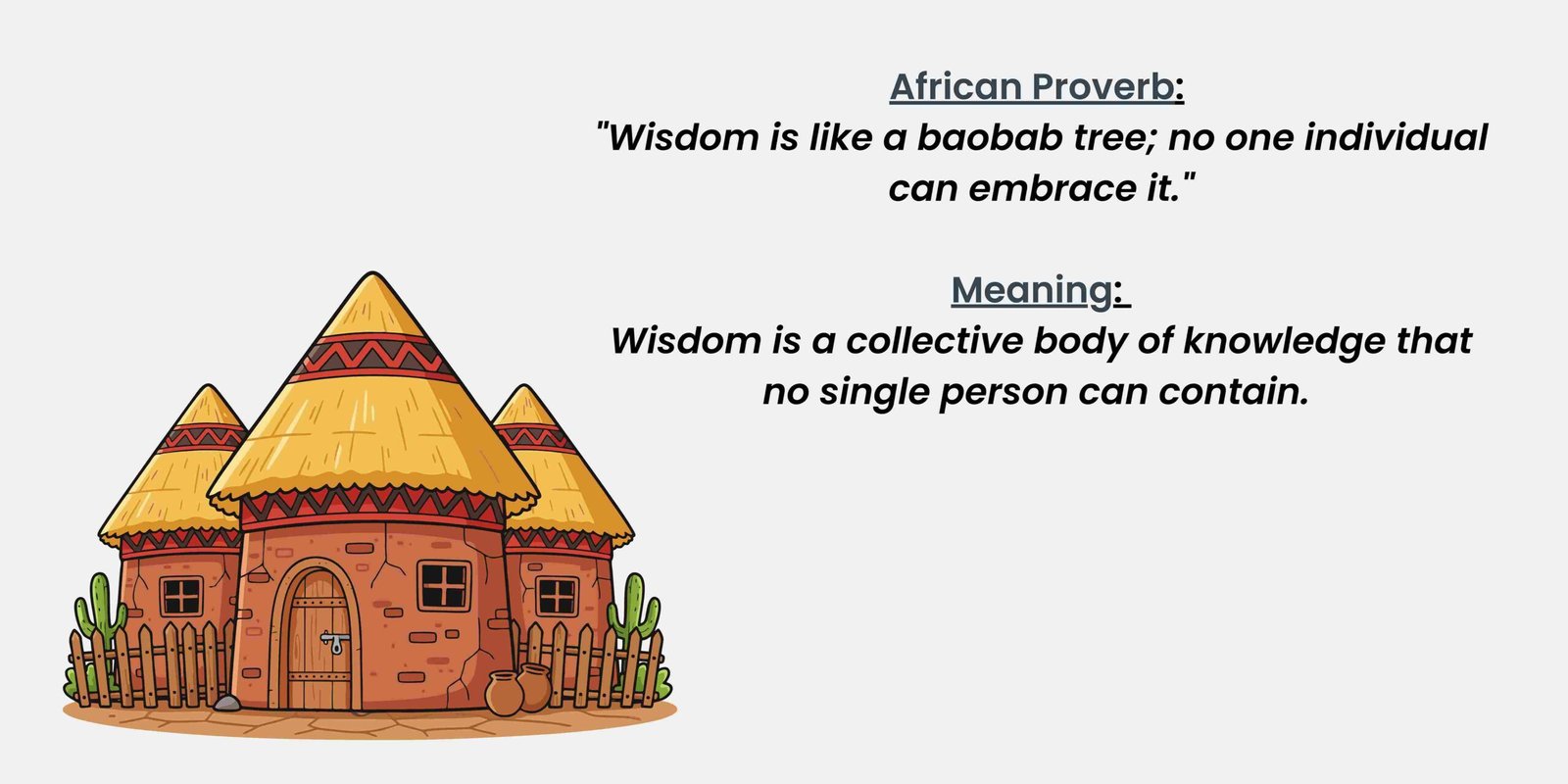
- “Wisdom is like a baobab tree; no one individual can embrace it.” (Akan, Ghana) Knowledge is too vast for any one person to master completely. Wisdom is collective and requires humility.
- “The one who asks questions doesn’t lose their way.” (Akan, Ghana) Curiosity and willingness to seek help prevent errors. There’s no shame in not knowing.
- “Ears that do not listen to advice, accompany the head when it is chopped off.” (Yoruba, Nigeria) Those who refuse guidance will suffer the consequences of their stubbornness alongside those who tried to help them.
- “No matter how hot your anger is, it cannot cook yams.” (Yoruba, Nigeria) Anger is ultimately unproductive. Emotions alone don’t accomplish practical goals.
- “A roaring lion kills no game.” (Various African cultures) Actions speak louder than words. Threats and boasting don’t achieve results.
- “Even the best cooking pot will not produce food.” (Various African cultures) Having tools or potential means nothing without effort and action. You must use what you have.
- “The fool speaks, the wise man listens.” (Ethiopian) Wisdom comes from observation and listening, not from constant talking.
- “A single bracelet does not jingle.” (Congolese) Community and relationships create fullness in life. Isolation is incomplete.
- “He who thinks he is leading and has no one following him is only taking a walk.” (Malawian) Leadership requires followers. Without support and influence, you’re not actually leading.
- “Where you will sit when you are old shows where you stood in youth.” (Yoruba, Nigeria) The consequences of your youth follow you into old age. Your choices today determine your future circumstances.
- “By trying often, the monkey learns to jump from the tree.” (Buganda, Uganda) Persistence and practice lead to mastery. Keep attempting, and you’ll eventually succeed.
- “A bird will always use another bird’s feathers to feather its own nest.” (Ashanti, Ghana) We build upon what others have created. Progress comes from learning from those who came before.
- “Cross the river in a crowd and the crocodile won’t eat you.” (African proverb) There’s safety in numbers and community. Shared risks are diminished risks.
- “Do not look where you fell, but where you slipped.” (Liberian) Focus on the root cause of problems, not just the outcome. Understanding what led to failure prevents repetition.
- “A healthy person who begs for food is an insult to a generous farmer.” (Ghanaian) Those with ability but who refuse to work take advantage of others’ generosity. Self-reliance matters when you’re capable.
- “The sun will shine on those who stand before it shines on those who kneel under them.” (Various African cultures) Those who take initiative and stand up for themselves will receive opportunities first. Action precedes reward.
- “When the music changes, so does the dance.” (Hausa, West Africa) Adaptability is essential. When circumstances change, you must adjust your approach accordingly.
- “A man who uses force is afraid of reasoning.” (Kenyan) Violence and aggression often mask intellectual weakness. Those confident in their arguments don’t need force.
- “The teeth are smiling, but is the heart?” (Congolese) Outward appearances can be deceiving. Someone may seem friendly while harboring negative feelings.
- “The lizard that jumped from the high iroko tree to the ground said he would praise himself if no one else did.” (Yoruba, Nigeria) If others don’t recognize your achievements, acknowledge them yourself. Self-appreciation is valid.
- “Two men in a burning house must not stop to argue.” (Ashanti, Ghana) During emergencies or crises, put aside disagreements and focus on survival. Some conflicts must wait.
- “He who cannot dance will say the drum is bad.” (Ashanti, Ghana) People often blame external factors for their own shortcomings. Taking responsibility is harder than making excuses.
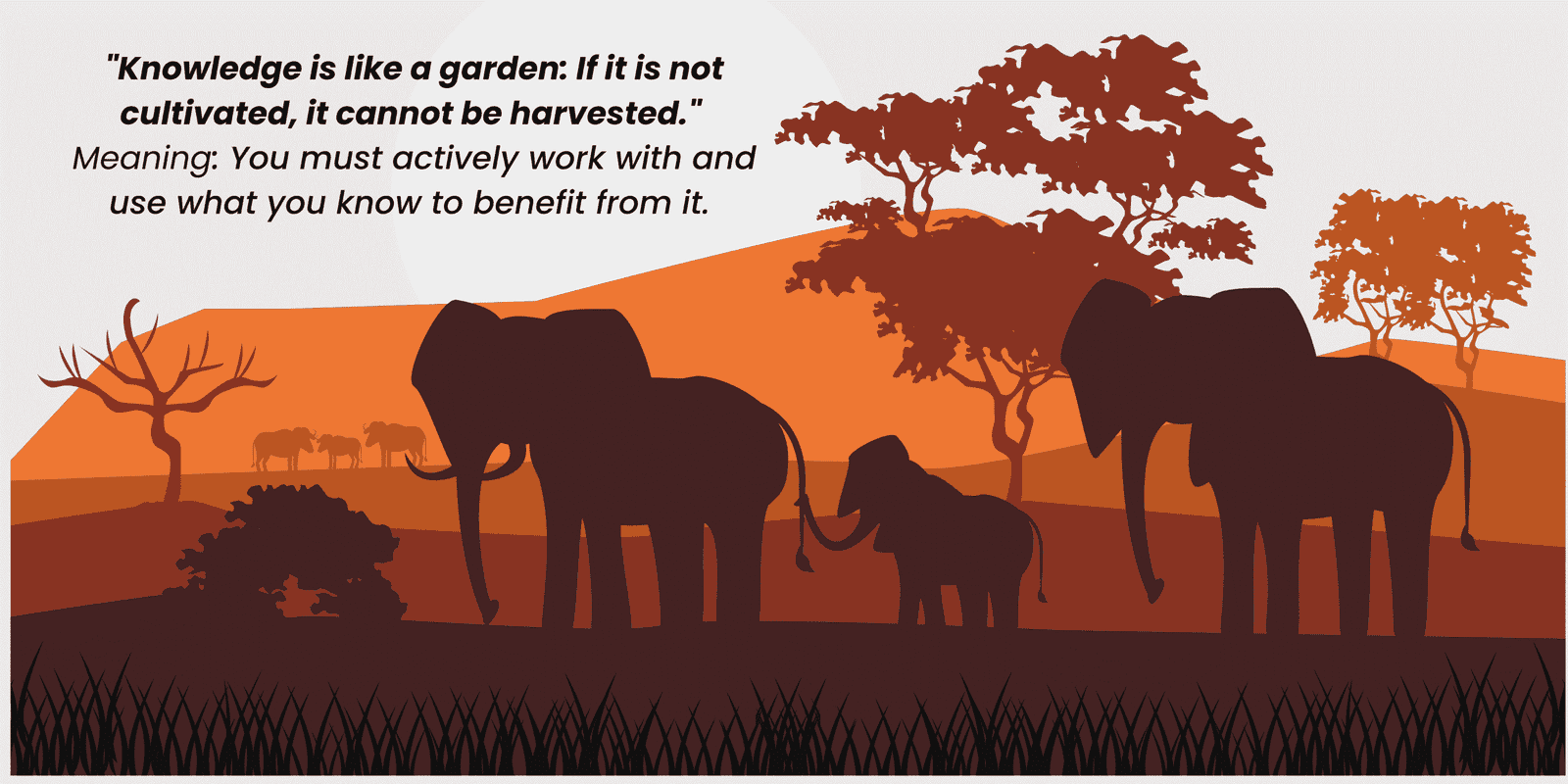
- “Knowledge is like a garden: if it is not cultivated, it cannot be harvested.” (Guinean) Learning requires continuous effort and attention. Knowledge unused or unpracticed withers away.
- “The ruin of a nation begins in the homes of its people.” (Ashanti, Ghana) Social decay starts at the family level. Strong societies are built on strong families.
- “A spider’s cobweb isn’t only its sleeping spring but also its food trap.” (African proverb) One resource can serve multiple purposes. Be creative and efficient with what you have.
- “The heart of the wise man lies quiet like limpid water.” (Cameroonian) Wisdom brings inner peace and calm. Turmoil indicates a troubled mind.
- “You cannot build a house for last year’s summer.” (Ethiopian) You can’t change the past. Focus your energy on the present and future.
- “A fly that has no one to advise it follows the corpse into the grave.” (Various African cultures) Without guidance and counsel, you’ll follow destructive paths. Mentorship protects us from fatal errors.
- “If you damage the character of another, you damage your own.” (Yoruba, Nigeria) Harming others’ reputations ultimately reflects poorly on you. Integrity is reciprocal.
- “The one who loves an unsightly person is the one who makes him beautiful.” (Ganda, Uganda) Love transforms perception. What we cherish becomes beautiful to us.
- “An army of sheep led by a lion can defeat an army of lions led by a sheep.” (Various African cultures) Leadership quality determines outcomes more than the followers’ strength. Good leadership elevates everyone.
- “Before you heal someone, ask him if he’s willing to give up the things that made him sick.” (African proverb) Real change requires addressing root causes. People must be willing to abandon destructive habits.
- “The wealth which enslaves the owner isn’t wealth.” (Yoruba, Nigeria) Possessions that control you rather than serve you are burdens, not blessings. True wealth brings freedom.
- “When a king has good counselors, his reign is peaceful.” (Ashanti, Ghana) Leaders are only as good as the advisors they choose to listen to. Wise counsel creates stability.
- “A fight between grasshoppers is a joy to the crow.” (Various African cultures) When two parties conflict, a third often benefits. Internal division creates opportunity for external exploitation.
- “He who refuses to obey cannot command.” (Kenyan) Leadership requires understanding what it means to follow. You must respect authority to wield it well.
- “The old woman looks after the child to grow its teeth and the young one in turn looks after the old woman when she loses her teeth.” (Akan, Ghana) Generational reciprocity is essential. We care for each other across the life cycle.
- “Wherever a man goes to dwell, his character goes with him.” (Yoruba, Nigeria) You can’t escape your nature by changing locations. Character follows you everywhere.
- “Patience can cook a stone.” (African proverb) With enough persistence and time, even the impossible becomes possible. Never underestimate patience.
- “If you offend, ask for pardon; if offended, forgive.” (Ethiopian) Take responsibility when you’re wrong and show grace when you’re wronged. This maintains relationships.
- “A cutting word is worse than a bowstring; a cut may heal, but the cut of the tongue does not.” (Mauritanian) Words cause deeper wounds than physical injury. Emotional damage lasts longer and heals slower.
- “Milk and honey have different colors, but they share the same house peacefully.” (African proverb) Differences don’t preclude harmony. Unity doesn’t require uniformity.
- “A single stick may smoke, but it will not burn.” (African proverb) Individual effort has limits. Real power and warmth come from collective action.
- “The fool is thirsty in the midst of water.” (Ethiopian) Some people can’t recognize the resources available to them. Ignorance creates unnecessary suffering.
- “He who is unable to dance says that the yard is stony.” (Masai, Kenya/Tanzania) People blame circumstances for their own inadequacies rather than working to improve themselves.