
Empowerment in Safeguarding: Voice, Choice, and Consent
The empowerment principle in safeguarding focuses on enabling vulnerable individuals to make informed decisions about their lives.
It means ensuring their voice is heard, supporting them to exercise choice, and tailoring interventions to their personal goals rather than imposing solutions.
At its core, empowerment is about providing control, clear information, and meaningful options so people can actively participate in decisions affecting their well-being.
This approach treats individuals as partners in their protection and promotes independence, dignity, and self-determination.
What Does Empowerment Mean in Safeguarding?
Empowerment is about creating an environment where individuals feel confident to express their views, make informed decisions, and participate actively in their care or protection.
Empowerment is one of the six core safeguarding principles—alongside Prevention, Proportionality, Protection, Partnership, and Accountability.
It focuses on giving individuals agency within safeguarding processes by ensuring they have control, choice, and a voice in decisions that affect their lives.
It involves:
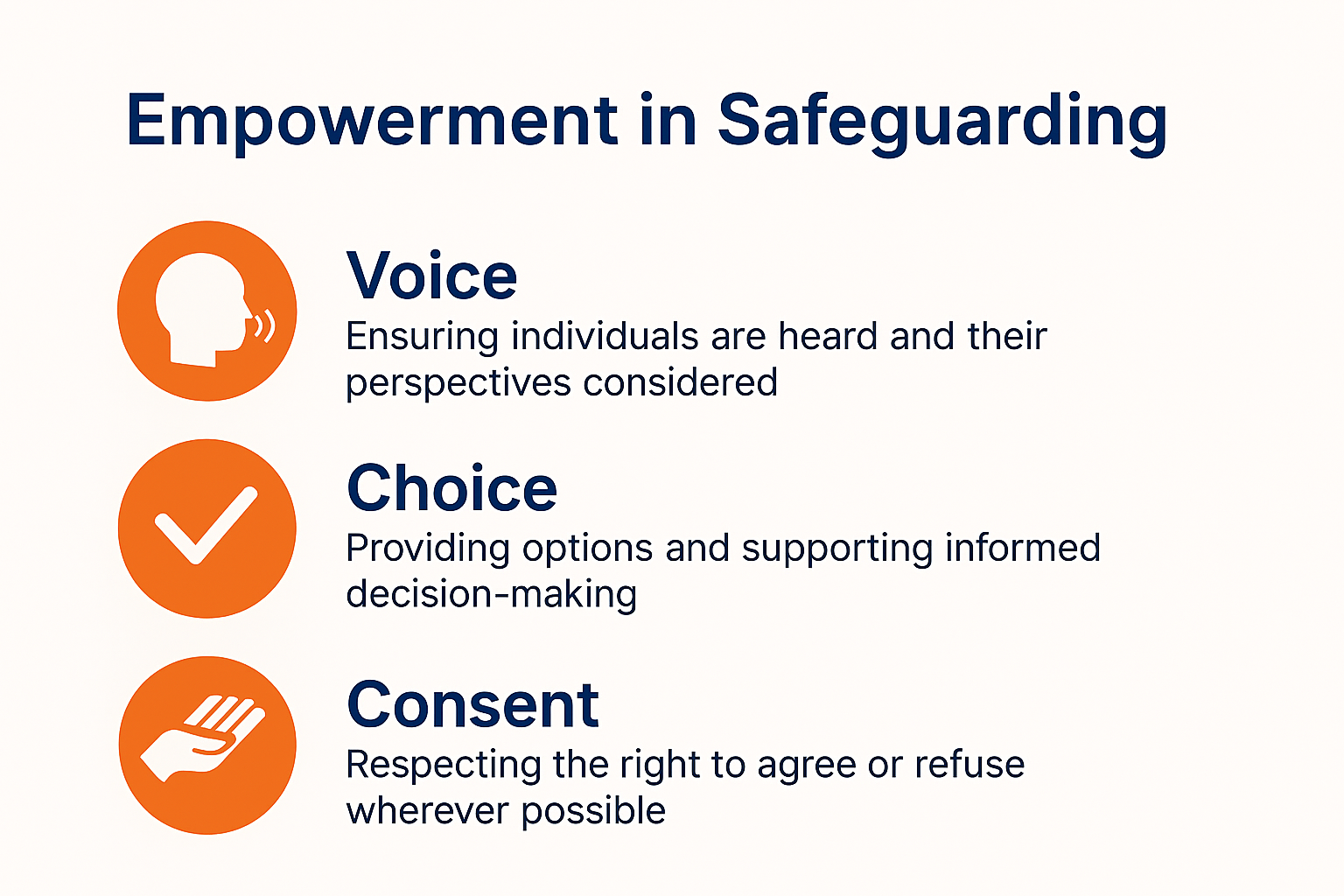
- Voice: Ensuring individuals are heard and their perspectives considered.
- Choice: Providing options and supporting informed decision-making.
- Consent: Respecting the right to agree or refuse, wherever possible.
This principle aligns with human rights frameworks and ethical practice.
When people feel empowered, they are more likely to engage positively with safeguarding processes, reducing feelings of helplessness and promoting resilience.
Key Aspects of Empowerment in Safeguarding
- Informed Consent: Supporting individuals to fully understand their options and agree to any actions or support offered.
- Personalised Outcomes: Engaging people in defining what they want from the safeguarding process and using their goals to guide decisions.
- Active Participation: Promoting self-determination by involving individuals as equal partners in planning their care and safety.
- Information and Choice: Providing clear, accessible information and a range of choices so individuals can manage risks and make informed decisions.
- Advocacy: Ensuring access to advocacy or independent advocates where needed, so every person’s voice is heard and respected.
You can look at examples of how safeguarding works in regards to empowerment and the six core principles.
Why Autonomy Strengthens Safeguarding
Respecting autonomy does not mean ignoring risks; rather, it acknowledges that safeguarding should not be paternalistic.
Overly controlling approaches can erode trust and discourage disclosure of harm. By contrast, empowerment fosters collaboration and transparency.
For example, in adult safeguarding, the Care Act 2014 (UK), one of the legal safguarding frameworks, enshrines empowerment as a key principle, stating that individuals should be supported to make their own decisions wherever possible.
This approach recognizes that safeguarding is not just about protection—it is about enabling people to live fulfilling lives, even when risks exist.
Balancing Empowerment and Risk in Safeguarding Decisions
Empowerment becomes complex when safety concerns or capacity issues arise.
Professionals often face the challenge of balancing an individual’s right to autonomy with the duty to prevent harm.
This tension is particularly evident in cases involving:
- Mental Capacity: When a person lacks capacity to make certain decisions, safeguarding must involve best-interest assessments while still seeking their input.
- High-Risk Choices: Individuals may choose to live in ways that involve risk—such as refusing medical treatment or remaining in a relationship despite abuse. Here, empowerment means respecting informed choices while ensuring risks are understood.
Strategies for Balancing Empowerment and Risk
- Risk Enablement: Instead of eliminating all risk, consider how risks can be managed to allow autonomy. For example, supporting someone to live independently with assistive technology rather than insisting on residential care.
- Proportionality: Interventions should be the least restrictive necessary to achieve safety. Over-intervention can undermine empowerment and create dependency.
- Collaborative Decision-Making: Engage individuals in discussions about risks and options. Use clear, accessible language to ensure understanding.
- Advocacy and Support: Where capacity or communication barriers exist, independent advocates can help ensure the person’s voice is heard.
How Empowerment Works in Practice
Empowerment in safeguarding is a practical approach embedded in everyday interactions.
Here are examples of how it works:
- Person-Centered Planning: Care plans are developed with active input from the individual, ensuring their preferences shape the support provided.
- Accessible Information: Providing information in formats that suit the person’s needs—such as easy-read documents or interpreters—so they can make informed choices.
- Involving Individuals in Risk Assessments: Rather than professionals making decisions in isolation, individuals are invited to discuss potential risks and strategies to manage them.
- Use of Advocacy Services: Independent advocates help individuals understand their rights and express their wishes, particularly where capacity or communication is limited.
- Consent-Based Interventions: Before any safeguarding action, professionals seek consent wherever possible, explaining implications clearly and respecting refusals unless overriding risk factors exist.
These practices demonstrate that empowerment is not about abandoning responsibility—it is about partnership. Working collaboratively, safeguarding professionals can protect individuals while honoring their autonomy.
Practical Examples
- Direct Involvement: A practitioner asks a vulnerable adult, “What do you want to happen next?” and uses that response to shape the safeguarding plan.
- Information Provision: A care provider explains various support options to a person with disabilities, allowing them to choose the service that best suits their needs.
- Building Resilience: Teaching children they have the right to say “no” or speak up about uncomfortable situations, which empowers them to protect themselves.
- Advocacy: Using an independent advocate for individuals who have substantial difficulty being involved in decision-making, ensuring their voice is still heard.
The principle of empowerment means supporting and encouraging individuals to make their own decisions and provide informed consent.
It shifts safeguarding from “doing things to” a person toward working “with them” as partners to achieve the outcomes they value.