
Six Rights of Medication Administration: A Complete Guide to Safe Nursing Practice
The six rights of medication administration build on the traditional Five Rights by adding right documentation, a principle recognised across NHS and international nursing standards as essential to safe and accountable medicines practice.
Together, these six principles, right patient, right medication, right dose, right route, right time, and right documentation, form the minimum standard expected of any registered healthcare professional administering medicines.
While some organisations extend this framework further to include rights such as right reason or right assessment, the six rights remain widely taught as the core foundation of safe administration, providing a structured checklist that reduces reliance on memory and supports consistent, auditable practice.
📚Read Also: The Rights of Medication Administration - Complete Guide.
Why 6Rs of Medication, Not 5 Rs?
The original Five Rights framework focused solely on the point of administration itself: confirming the correct patient, medicine, dose, route, and time. While these checks remain essential, they do not, on their own, capture what happens after a medicine has been given.
The addition of right documentation reflects a broader understanding of medicines safety, one that recognises accurate record-keeping as inseparable from safe administration.
Without clear documentation, continuity of care is put at risk, clinical accountability is weakened, and the likelihood of duplicate or missed doses increases significantly, particularly during handover between shifts or care settings.
The Six Rights of Medication Administration
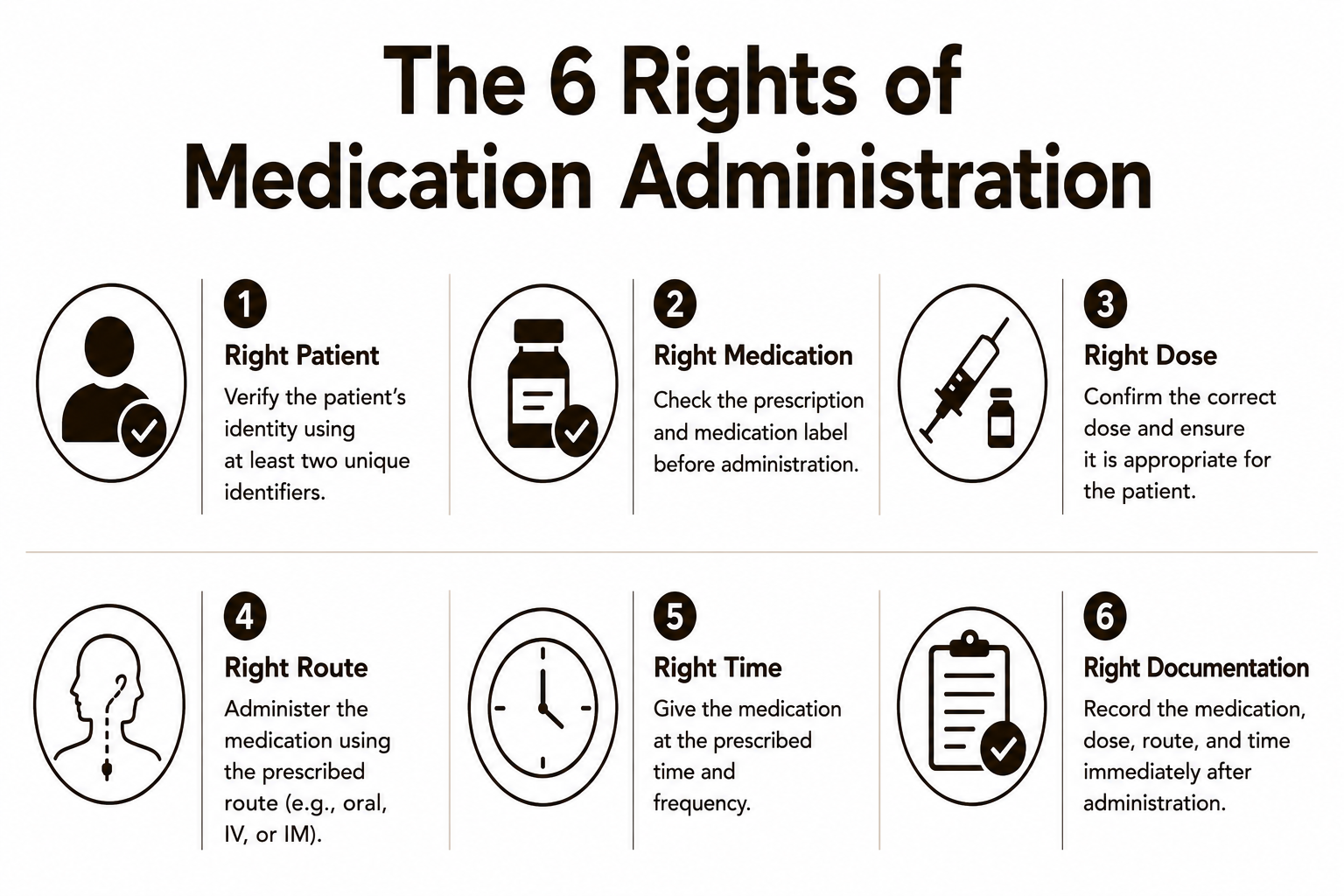
1. Right Patient
The first right in the 6rs of medication is the patient. Positive identification should be confirmed using at least two identifiers, typically full name and date of birth, checked against the medication administration record (MAR) or electronic prescribing system. Verbal confirmation or familiarity with the patient should never replace formal identity checks, particularly with patients who are confused, sedated, or unable to communicate clearly.
2. Right Medication
The medicine selected should be checked carefully against the prescription, with particular attention to look-alike, sound-alike drug names and packaging. Allergy status and known contraindications should be reviewed before preparation begins.
3. Right Dose
The prescribed dose must be appropriate to the patient's age, weight, and clinical condition, including renal and hepatic function where relevant. High-risk medicines, such as insulin, anticoagulants, opioids, and paediatric doses, should be subject to independent double-checking as standard practice.
4. Right Route
Medicines must be administered via the route specified in the prescription, whether oral, intravenous, intramuscular, subcutaneous, or topical. Administering a medicine by the wrong route can significantly alter its absorption, effectiveness, and safety profile.
5. Right Time
Medicines should be given within the time window set by local policy. Particular care should be taken with time-critical medicines, including antibiotics, anticonvulsants, and Parkinson's disease medication, where delays can reduce clinical effectiveness or lead to therapeutic failure.
6. Right Documentation
Administration should be recorded accurately and promptly once the medicine has been given, never in advance of administration. Clear, contemporaneous documentation supports safe handover, continuity of care, and clinical accountability, and provides an essential audit trail in the event of a medicines-related incident.
Implementing 6rs of Medication with Action, Method Check for Safety
1. Right Person
Action: Verify the patient's identity before administering medication.
Method: Use two unique identifiers, such as the patient's full name and date of birth.
Check: Match the patient's ID wristband with the medication administration record (MAR).
2. Right Medication
Action: Confirm that the correct medication is being administered.
Method: Check the medication label and expiry date.
Check: Compare the medication label with the prescription and MAR at least three times.
3. Right Dose
Action: Ensure the prescribed dose is accurate.
Method: Perform and verify any necessary dosage calculations.
Check: Confirm the dose matches the prescription.
4. Right Time
Action: Administer the medication at the prescribed time.
Method: Follow the ordered schedule and dosing intervals.
Check: Review the MAR to confirm when the previous dose was administered.
5. Right Route
Action: Administer the medication using the prescribed route.
Method: Confirm whether it should be given orally, intravenously, intramuscularly, topically, or by another route.
Check: Never administer medication if the route is unclear or missing from the prescription.
6. Right Documentation or Right to Refuse
Right Documentation
Record the medication immediately after administration.
Document the medication, dose, route, time, and any relevant observations.
Right to Refuse
Respect the patient's right to decline medication.
Document the refusal and inform the appropriate healthcare professional.
Difference Between the 5, 6, and 10 Rs of Medication
| System | Rights Included | Key Purpose & Context |
|---|---|---|
| 5 Rights |
|
The Core Foundation Forms the absolute baseline safety standard. It focuses entirely on the immediate physical act of preparing and administering the substance. |
| 6 Rights |
Includes all 5 Rights above, plus:
|
The Accountability Standard Adds a legal and administrative safety net. It ensures that actions are instantly recorded to prevent dangerous double-dosing by other staff. |
| 10 Rights |
Includes all 6 Rights above, plus:
|
The Holistic Clinical Approach Expands into comprehensive patient care. It covers pre-administration checks (vitals), patient understanding, and post-administration tracking for side effects. |
Applying the 6rs of Medication in Clinical Practice
- Use a three-point check: verify the medicine against the prescription when selecting it, when preparing it, and again at the point of administration.
- Reduce interruptions during medicine rounds through the use of "do not disturb" protocols or designated quiet zones.
- Make use of electronic prescribing and barcode-assisted administration systems, where available, to support accurate checking.
Apply independent double-checking for all high-risk medicines. - Document administration in real time, rather than relying on memory at the end of a shift.
- Treat any deviation from the six rights, however minor, as an opportunity for reflection and learning within a just and open reporting culture.
Conclusion
The six rights of medication administration, right patient, right medication, right dose, right route, right time, and right documentation, represent the core standard for safe medicines practice.
By consistently applying these principles at every administration, healthcare professionals can reduce the risk of medication errors, strengthen clinical accountability, and safeguard patient wellbeing throughout the course of care.