
Fire Safety Laws and Regulations in the UK: What Homes and Businesses Must Know
Introduction
Fire safety is of paramount importance in the UK, affecting homeowners, landlords, employers, and building managers. With evolving legislation introduced in response to tragedies such as Grenfell Tower, regulations have become more rigorous to ensure the safety of all occupants.
Central to this framework are the “Responsible Persons”—typically property owners, employers, or landlords—who must manage and document fire risks, enforce safety measures, and coordinate responses.
This article explores the key fire safety laws, examines significant updates set for 2026, outlines requirements tied to building height, and offers actionable steps for compliance.
Core Legislation for Businesses and Common Areas
Regulatory Reform (Fire Safety) Order 2005 (FSO)
The FSO, effective since October 2006, is the foundational legislation governing fire safety in all non-domestic premises and shared areas of residential buildings (such as corridors and staircases). Under this order:
- Fire safety responsibilities fall on the “Responsible Person.”
- They must perform a suitable and sufficient fire risk assessment, identifying hazards, persons at risk, and putting precautions in place (exits, alarms, fire doors, signage).
- Implement control measures, keep records, maintain equipment, and train occupants.
- Cooperate when multiple Responsible Persons share duty over parts of a property (e.g., landlords and tenants).
Local fire authorities enforce compliance and can issue enforcement notices, fines, or pursue prosecution for serious violations.
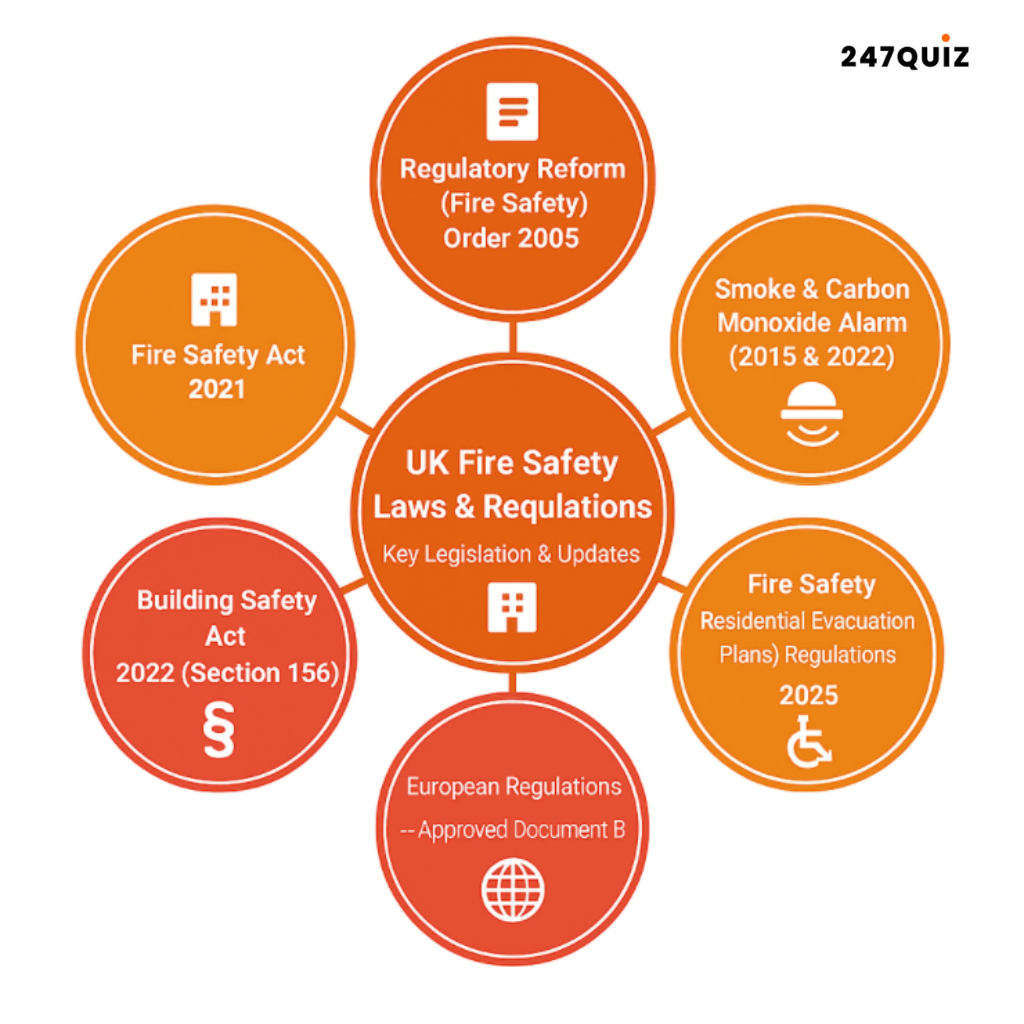
Building Safety Act 2022 (Section 156)
Effective from October 2023, Section 156 amends the FSO to strengthen fire safety duties across all non-domestic premises, regardless of size.
Key obligations include:
- Recording written Fire Risk Assessments (FRA) and details of fire safety arrangements.
- Recording assessors’ identities.
- Sharing fire safety information with residents of multi-occupied buildings.
- Enhancing cooperation between Responsible Persons in shared buildings.
These amendments apply to all non-domestic premises and communal spaces—workplaces, shops, care homes, and HMOs.
Building Regulations 2010 – Approved Document B
These regulations govern fire safety in building design and construction:
- Volume 1: Dwellings – smoke alarms, escape routes, fire resistance.
- Volume 2: Non-domestic buildings – compartmentation, fire lifts, firefighter access.
Recent updates include mandatory sprinklers in care homes and evacuation lifts in tall residential blocks.
Fire Safety Act 2021 & Fire Safety (England) Regulations 2022
Introduced after the Grenfell Tower tragedy, these laws clarify that fire risk assessments must include external walls, cladding, balconies, windows, and entrance doors.
The 2022 regulations require:
- Secure information boxes for fire services.
- Updated fire strategy information for residents.
- Emergency evacuation statements for high-rise buildings.
Key Requirements for 2026
Personal Emergency Evacuation Plans (PEEPs)
Under the Fire Safety (Residential Evacuation Plans) (England) Regulations 2025, from 6 April 2026, Responsible Persons in specified residential buildings must:
- Identify residents with cognitive or physical impairments (“relevant residents”).
- Offer a person-centred fire risk assessment (PCFRA).
- Prepare a Personal Emergency Evacuation Plan (PEEP).
- Record mitigation actions and evacuation statements.
- Secure residents’ consent and share relevant evacuation information with local Fire and Rescue Services.
- Review PEEPs annually or when circumstances change.
This requirement targets buildings 18 m tall or over 11 m with simultaneous evacuation strategies.
Second Staircase Requirement
From 30 September 2026, Approved Document B (ADB) mandates a second common staircase in all new residential buildings that are 18 m or taller.
Transitional rules allow projects already underway to comply with previous requirements if they are sufficiently advanced by that date.
Transition to European Standards
The UK is phasing out the national BS 476 testing standard for fire doors and materials. BS 476 was removed on 2 March 2025 and will be fully replaced by BS EN 13501 and BS EN 1634-1 by 2 September 2029.
This shift increases consistency and transparency, aligning UK fire safety practices with European standards.
High-Rise Specific Duties
Buildings 18 m or taller are subject to additional obligations under the Fire Safety (England) Regulations 2022.
These include preparing electronic floor plans for each level that detail lifts, dry and wet risers, smoke control, and suppression systems, and providing these to the local Fire and Rescue Service.
A secure on-site information box must also be installed containing hard copies of plans, fire door certifications, and evacuation statements.
In addition, monthly checks of firefighting lifts and equipment are required, and any defects not resolved within 24 hours must be reported.
| Building Height | Obligations |
|---|---|
| All Multi‑occupied Residential | Provide residents with fire safety instructions and fire door information. |
| Over 11 m | Annual flat-entrance door checks; quarterly communal fire door inspections. |
| Over 18 m (High-Rise) | Monthly checks on firefighting lifts/equipment; secure info boxes; way‑finding signage; electronic floor plans. |
Actionable Steps for Compliance
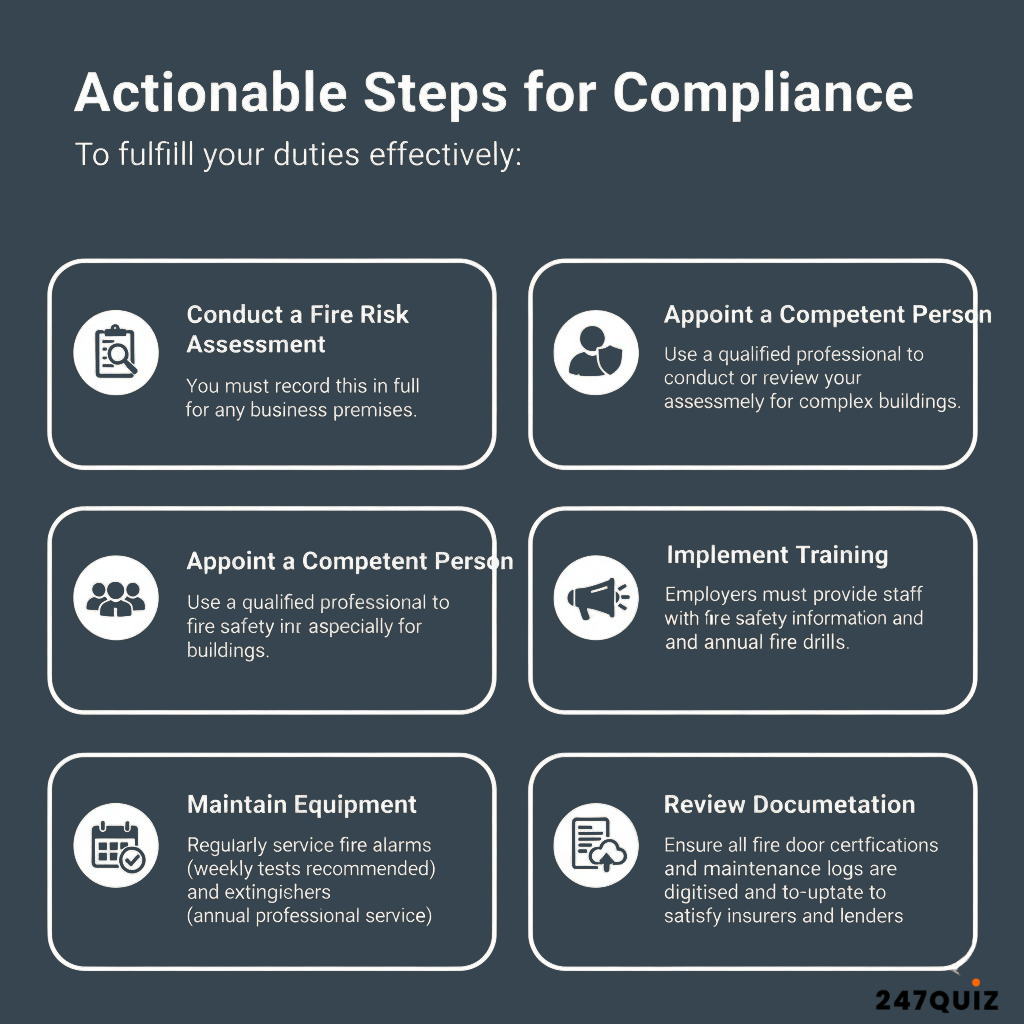
- Conduct a Fire Risk Assessment for Any Business Premises
- Legal requirement to fully record assessments per Section 156 of Building Safety Act 2022.
- Appoint a Competent Person
- Hire a qualified professional to conduct or review FRAs, especially for complex or high-risk buildings.
- Implement Training & Emergency Planning
- Provide staff with fire awareness and evacuation drills.
In high-rises, draft and review evacuation strategies and ensure PEEPs are in place from April 2026.
- Provide staff with fire awareness and evacuation drills.
- Maintain Equipment and Systems
- Test fire alarms weekly, maintain fire extinguishers annually.
In high-rise buildings, inspect fire safety lifts and risers monthly and report defects within 24 hours.
- Test fire alarms weekly, maintain fire extinguishers annually.
- Review and Update Documentation
- Keep digital logs of FRAs, maintenance, door certifications, lift checks, and evacuation records.
Ensure insurance and lenders have access to up-to-date documentation.
- Keep digital logs of FRAs, maintenance, door certifications, lift checks, and evacuation records.
- Prepare for 2026 Regulatory Changes
- Add a second staircase in new 18 m+ residential buildings; begin PEEPs process.
Ensure exterior wall systems and door clearances align with updated 2021 and 2022 regulations.
- Add a second staircase in new 18 m+ residential buildings; begin PEEPs process.
Building Safety Regulator’s Role
The Building Safety Regulator, under the Building Safety Act 2022, enforces standards for “higher-risk buildings” and monitors compliance with rigorous documentation, competency, and reporting requirements.
Enforcement and Penalties
- Local fire and rescue services, local authorities, Building Safety Regulator, or HSE may issue enforcement or prohibition notices, impose fines, and pursue criminal prosecutions.
- Penalties include:
- Up to £5,000 fines for breach of smoke/CO alarm regulations in rented homes.
- Unlimited fines and/or imprisonment for serious breaches of the FSO or Building Safety Act.
Conclusion
The UK’s fire safety landscape is dynamic and increasingly comprehensive. The framework—from 2005’s FSO, through the Fire Safety Act 2021, Building Safety Act 2022, and 2026 regulations—places strict duties on Responsible Persons to assess, record, and manage fire risks.
Buildings must meet evolving structural, procedural, and equipment standards:
- Conduct assessments, design safe evacuation routes, train occupants.
- Keep accurate digital documentation of assessments, maintenance, and evacuation planning.
- Incorporate forthcoming 2026 regulations: dual staircases, PEEPs, European material standards.
Persistent vigilance and proactive compliance are essential—not just to remain legally compliant, but to protect lives, property, and reputation.